

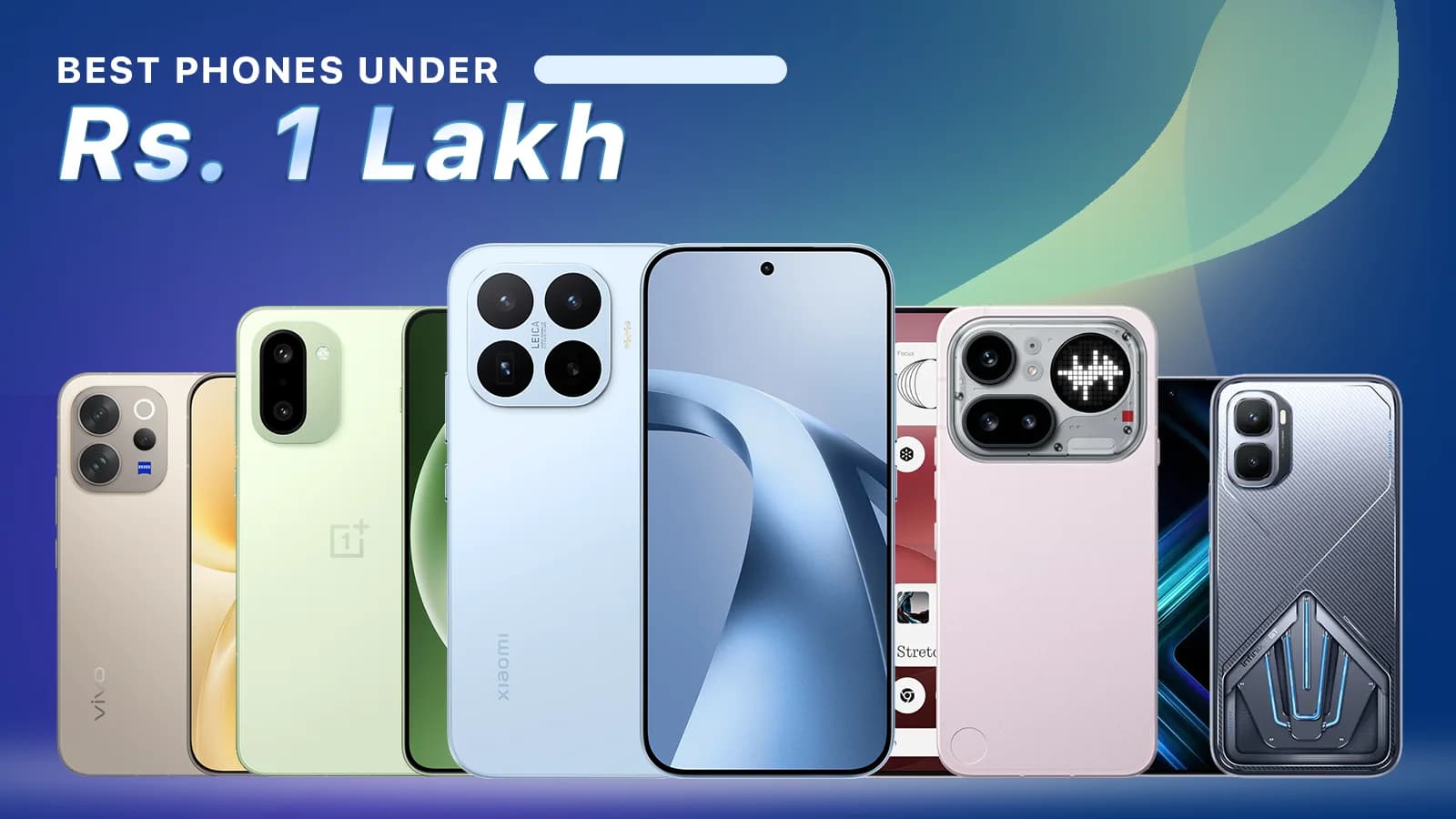
Quick Comparison: Top Phones Under 1 Lakh
| Phone | Display | Processor | Cameras | Battery | Best For |
| Xiaomi 17T (12/256GB) — Rs. 92,999 | 6.59”, 1.5K, 120Hz AMOLED | Dimensity 8500-Ultra (4nm) | 50MP main + 50MP telephoto + 12MP ultrawide + 32MP selfie | 6,500 mAh, 67W charging | Balanced all-rounder with 5x zoom |
| Nothing Phone 4a Pro (12/256GB) — Rs. 99,999 | 6.83”, 1.5K, 144Hz AMOLED | Snapdragon 7 Gen 4 (4nm) | 50MP main + 50MP telephoto + 8MP ultrawide + 32MP selfie | 5,080 mAh, 50W charging | Standout design, clean software, and dependable cameras |
| OnePlus 15R (12/256GB) — Rs. 98,499 | 6.83”, 1.5K, 165Hz AMOLED | Snapdragon 8 Gen 5 (3nm) | 50MP main + 8MP ultrawide + 32MP selfie | 7,400 mAh, 80W charging | Powerful performance and battery life |
| Infinix GT 50 Pro (12/256GB) — Rs. 84,999 | 6.78”, 1.5K, 144Hz AMOLED | Dimensity 8400 Ultimate (4nm) | 50MP main + 8MP ultrawide + 13MP selfie | 6,500 mAh, 45W charging | Great gaming features |
| Vivo V70 (8/256GB) — Rs. 84,999 | 6.59”, 1.5K, 120Hz AMOLED | Snapdragon 7 Gen 4 (4nm) | 50MP main + 50MP telephoto + 8MP ultrawide + 50MP selfie | 6,500 mAh, 90W charging | Good camera versatility, somewhat pocketable design |
How We Picked the Best Phones Under Rs. 1 Lakh
For this list, we looked at all the phones officially available in Nepal. Then we compared their strengths against what matters in day-to-day use: how quickly apps load, how well the phone handles longer gaming sessions, whether the display remains comfortable outdoors, how versatile the camera setup is, and whether the battery and charging combination suits a busy day. Here’s what we looked at:
- Price and value — We looked at the actual selling price of the exact RAM and storage variant of all mobile phones in Nepal, not some tempting “starting from” price. Then, we consider what you’re missing at that price, whether it’s a charger in the box, a decent ultrawide camera, or a longer software update promise. Saving Rs. 5,000 doesn’t mean much if you’re giving up a feature you’ll use every day. Also, since “under Rs. 1 lakh” is a hard limit, we only include variants that actually fall within the budget.
- Performance — The chipset and GPU are important, but they’re not the whole story. We also looked at how well the phone manages heat and how smooth it feels during everyday use. Benchmark scores give us a rough idea, but they don't tell you everything. That's why we pay attention to how a phone performs after 30 minutes of gaming, too.
- Software — A good software experience should feel clean, simple, and easy to use. We considered how much unnecessary preinstalled stuff you have to deal with, whether there are annoying ads, and how smoothly everything runs. Software updates matter just as much, so we checked how long the manufacturer promises to support the phone. That gives you a better idea of how long it'll stay secure and up to date.
- Display — We compared the screen type, size, refresh rate, resolution, and peak brightness, but the numbers aren't everything. What really matters is how the display feels in everyday use, from reading under Nepal’s bright sunshine to scrolling through apps and watching videos. A 165Hz refresh rate sounds impressive, but there's little point in having it if the rest of the phone can't make good use of it.
- Camera — Since every phone on our list has a 50MP main camera, megapixel counts aren't going to tell you much. Instead, we focused on how consistently the cameras performed in daylight and low light, how good portraits and selfies look, and how well video recording and stabilisation work. We also looked at whether the extra lenses are actually useful. A poor ultrawide or the lack of a zoom camera can be a bigger drawback than you'd think.
- Battery and charging — Battery capacity and charging speed are part of the picture, but what really matters is whether the phone can comfortably last through a normal day. A bigger battery doesn't always mean better battery life, since chipset efficiency, display settings, and network signal all play a part. We also checked whether a charger is included in the box, because having to buy one separately adds to the overall cost.
- Warranty and after-sales support — Buying a phone is about more than just the specs. We checked where it's being sold, who handles the warranty, whether local service centres in Nepal will accept it, and what the return or replacement policy looks like. It's also important to make sure the phone is officially distributed and properly registered for use on Nepali networks under MDMS.
Best Phones Under Rs. 1 Lakh
Xiaomi 17T — Best overall and for camera versatility
Price: Rs. 92,999
Variant: 12GB RAM, 256GB storage
| Specification | Details |
| Display | 6.59” 1.5K AMOLED panel, 120Hz refresh rate, 3,500 nits brightness |
| Processor | MediaTek Dimensity 8500-Ultra (4nm) |
| RAM / Storage | 12GB RAM, 256/512GB storage |
| Rear Camera | 50MP f/1.7 main + 12MP f/2.2 ultrawide + 50MP f/3.0 periscope telephoto (5x optical zoom) |
| Front Camera | 32MP f/2.2 sensor |
| Battery and Charging | 6,500 mAh with 67W charging |
| Network | 4G LTE, 5G |
| Software | HyperOS 3 on top of Android 16 |
If we had to hand one phone under Rs. 1 lakh to a friend and walk away, it would be the Xiaomi 17T. It doesn't try to win a single category by a mile. Instead, it avoids having a real weak spot, which is rarer than you'd think at this price. The Xiaomi 17T is a fairly compact phone with a 6.59” screen and a 200 gm body, while it also has IP68 dust/water resistance with Gorilla Glass 7i up front. The one design letdown here is its plastic frame, which we'd have loved to see in metal instead. Its 120Hz AMOLED display is just as excellent, with a fast 3,840Hz PWM dimming that’s kind to your eyes at night.

What we’re especially fond of is that despite carrying a smaller display than every other phone on our list, Xiaomi still managed to give us a sharp 1.5K resolution. Under the hood, its Dimensity 8500-Ultra isn't a true flagship-level chip, but in our testing, it felt very close to one for apps, multitasking, and everyday gaming. Then again, long gaming sessions make the phone slightly warm, so it isn't the one we'd pick for marathon sessions. If gaming is your priority, there are much more deserving phones in this segment.
The camera system is where the 17T becomes especially interesting. Alongside the 50MP main camera with OIS, it offers a proper 50MP 5x periscope telephoto and a 12MP ultrawide lens. That 5x optical reach is genuinely useful for street photography, distant subjects, and tighter portraits, while “Leica” tuning adds a distinctive look to all your photos. We found that its 6,500 mAh battery and 67W wired charging make the phone suitable for long days away from a charger as well. And in terms of software, HyperOS 3 is smooth and free of intrusive ads—while Xiaomi also promises 5 years of Android OS upgrades and 6 years of security updates.
Why buy it?
- Versatile cameras with a 5x telephoto lens; Leica optimization
- Compact 6.59” body with an IP68 rating
- Strong all-round performance with Dimensity 8500-Ultra
- All-day battery life with a 6,500 mAh battery; 67W charger is included
Things to consider
- Plastic frame feels less premium
- Xiaomi’s HyperOS feels less polished than some of the competition
- Gets slightly warm during long gaming sessions
Who should buy it: Buy the Xiaomi 17T if you want one balanced phone that handles photos, battery, screen, and everyday speed without compromise.
Who should look elsewhere: If you want pure gaming power or a more premium build quality, look at the Infinix GT 50 Pro or OnePlus 15R instead.
Check price: Xiaomi 17T
All Xiaomi Mobiles in Nepal: https://gbnstore.com/category/smartphones/xiaomi
Nothing Phone 4a Pro — Best for unique design and clean software
Price: Rs. 99,999
Variant: 12GB RAM, 256GB storage
| Specification | Details |
| Display | 6.83” 1.5K AMOLED panel, 144Hz refresh rate, 5,000 nits brightness |
| Processor | Qualcomm Snapdragon 7 Gen 4 (4nm) |
| RAM / Storage | 8/12GB RAM, 128/256GB storage |
| Rear Camera | 50MP f/1.88 main + 8MP f/2.2 ultrawide + 50MP f/2.88 periscope telephoto (3.5x optical zoom) |
| Front Camera | 32MP f/2.0 sensor |
| Battery and Charging | 5,080 mAh with 50W charging |
| Network | 4G LTE, 5G |
| Software | Nothing OS 4.1 on top of Android 16 |
The Nothing Phone 4a Pro is the most distinctive-looking phone on our list. Instead of another familiar glass slab, we get a metal body, a cleaner rear design, and the “Glyph Matrix” lighting system. Made up of 137 individually controlled mini-LEDs, the Glyph Matrix sits on the back of the phone and does much more than just look pretty. It can display notifications, indicate incoming calls, show battery status, and even work as a digital clock, timer, selfie mirror, and camera countdown. The result is a lighting system that's not just a visual gimmick but also a genuinely useful way to stay informed while keeping your phone face down.

Nothing OS 4.1, based on Android 16, is another reason to buy this phone among all the other options available in Nepal. It's clean, quick, and free of clutter, and in our testing it felt smoother after a couple of updates. And while its Snapdragon 7 Gen 4 chipset is among the weakest for gaming, we found it to be perfectly smooth enough for social media, streaming, and camera use. Speaking of cameras, its 3.5x periscope telephoto is our favourite lens on this phone. Its 50MP main camera also takes good daylight shots with solid highlight control, although the 8MP ultrawide is clearly the weak link.
The Phone 4a Pro brings a modest 5,080 mAh battery that should cover a typical day of mixed use, although its battery capacity is smaller than every other device on our list. Nothing doesn’t ship a charger inside the box either, so that’s another thing you should factor in. And since IP65 dust and splash resistance is a few steps below the IP68 rating, the Nothing Phone 4a Pro might be a tough sell for some.
Why buy it?
- Premium metal build and a unique “Glyph Matrix” design
- Clean, smooth Nothing OS software
- A reliable set of cameras with a strong 3.5x telephoto lens
- A big, bright 144Hz AMOLED display
Things to consider
- Snapdragon 7 Gen 4 is not the strongest performer for the price
- An average 8MP ultrawide camea; basic IP65 rating
- Smaller battery than most rivals; no charger in the box either
Who should buy it: Choose the Nothing Phone 4a Pro if you value a unique design, a clean interface, a large display, and a useful telephoto camera more than top-tier performance.
Who should look elsewhere: We would look at the Xiaomi 17T for a stronger all-round package at a lower price, or the OnePlus 15R for better performance and a larger battery.
Check price: Nothing Phone 4a Pro
All Nothing Mobiles in Nepal: https://gbnstore.com/category/smartphones/nothing
OnePlus 15R — Best for performance and battery
Price: Rs. 98,499
Variant: 12GB RAM, 256GB storage
| Specification | Details |
| Display | 6.83” 1.5K AMOLED panel, 165Hz refresh rate, 3,600 nits brightness |
| Processor | Qualcomm Snapdragon 8 Gen 5 (3nm) |
| RAM / Storage | 12GB RAM, 256/512GB storage |
| Rear Camera | 50MP f/1.8 main + 8MP f/2.2 ultrawide |
| Front Camera | 32MP f/2.0 sensor |
| Battery and Charging | 7,400 mAh with 80W charging |
| Network | 4G LTE, 5G |
| Software | OxygenOS 16 on top of Android 16 |
OnePlus 15R is what we'd recommend to anyone who says, "I just want it to be fast and never die". It pairs a flagship Snapdragon 8 Gen 5 with a 7,400 mAh battery and a 165Hz screen, and unlike many spec-heavy phones, the pieces genuinely work well together. Since some games like PUBG and Call of Duty are actually playable at a smooth 165 fps on the OnePlus 15R. The phone doesn’t get that hot either, with the thermals staying below the comfortable 40°C mark even after around 20 minutes of continuous gameplay.

The 7,400 mAh battery is another major advantage. It is the largest battery phone on our list, and 80W charging gives us a practical way to top it up quickly. And under moderate use, we were able to stretch it well beyond a single day of use; heavy gaming and mobile data will naturally reduce that. OnePlus 15R also has an aluminium frame, a glass back, and IP68 and IP69K protection, so it's built to last.
But cameras are where OnePlus yields. Its 50MP main camera is fine in good light, but photos can look a little flat or overly contrasty. The 8MP ultrawide is also poor; there's no dedicated telephoto lens, and portraits at 1x and 2x are underwhelming. Selfies from the 32MP front camera are decent, and 4K 30 fps video is usable. If photography is your priority, we’d say the Vivo V70 and Xiaomi 17T are better picks. The OnePlus 15R’s price is easier to justify if you value performance, battery life, and a nice display more than anything else.
Why buy it?
- Fastest chip in this price category
- A huge 7,400 mAh battery with 80W fast charging
- Large 165Hz AMOLED display for gaming and streaming
- Smooth OxygenOS software; 4 + 6 years of updates
Things to consider
- Average cameras with no telephoto lens
- Not all games make full use of the 165Hz refresh rate
Who should buy it: We would recommend the OnePlus 15R to gamers, power users, and anyone who wants a fast phone with a battery that does not need frequent charging.
Who should look elsewhere: If photography, zoom, and selfies matter more than peak performance, we would choose the Vivo V70 or Xiaomi 17T instead.
Check price: OnePlus 15R
All OnePlus Mobiles in Nepal: https://gbnstore.com/category/smartphones/oneplus
Infinix GT 50 Pro — Best for gaming
Price: Rs. 84,999
Variant: 12GB RAM, 256GB storage
| Specification | Details |
| Display | 6.78” 1.5K AMOLED panel, 144Hz refresh rate, 4,500 nits brightness |
| Processor | MediaTek Dimensity 8400 Ultimate (4nm) |
| RAM / Storage | 12GB RAM, 256/512GB storage |
| Rear Camera | 50MP f/1.8 main + 8MP f/2.2 ultrawide |
| Front Camera | 13MP f/2.2 sensor |
| Battery and Charging | 6,500 mAh with 45W charging |
| Network | 4G LTE, 5G |
| Software | XOS 16 on top of Android 16 |
While the OnePlus 15R is the most powerful phone on our list, we are more impressed by the overall gaming experience on the Infinix GT 50 Pro instead. Its design, cooling system, and controls are built around mobile gaming. Under the hood is the Dimensity 8400 Ultimate with 12GB of LPDDR5X RAM and UFS 4.1 storage, and this combination comfortably handles 144 fps gameplay on popular titles like Mobile Legends and Call of Duty.

Whereas we could also play PUBG Mobile with a smooth 120 fps average and a steady 5% low fps on the GT 50 Pro. Its “HydroFlow” liquid cooling with a 7,700mm² vapor chamber system makes long gaming sessions noticeably more comfortable too. Infinix even includes an external cooling fan in the box for free to keep the thermals in check. While the built-in pressure-sensitive shoulder triggers that can be mapped to up to 8 points and double as camera zoom or screen shortcuts are a neat addition too.
Up front, you’re looking at a 6.78” AMOLED panel with a 144Hz refresh rate. Its 6,500 mAh battery supports 45W wired charging, as well as 30W wireless charging—making it the only phone on our list that can charge wirelessly. The GT 50 Pro’s cameras are more of an everyday setup than a reason to buy the phone. A 50MP main camera with OIS can handle casual daylight photography, and the 8MP ultrawide is handy when we need a wider frame, but neither replaces a stronger zoom system. It costs Rs. 13,500 less than the OnePlus 15R, and for us, the main reason to choose the Infinix GT 50 Pro is simple: it's the cheapest way here to get a quality gaming experience with a competent cooling system.
Why buy it?
- Liquid cooling system with pressure-sensitive gaming triggers
- Dimensity 8400 Ultimate chip; high-frame-rate gaming
- A large 6,500 mAh battery with wireless charging support
- Sharp 1.5K AMOLED display with a 144Hz refresh rate
Things to consider
- Only IP64 dust/splash protection
- Infinix’s XOS software includes some pre-installed apps
- Basic cameras with a weak ultrawide lens
Who should buy it: Go with the Infinix GT 50 Pro if gaming is your clear priority and you want dedicated controls, cooling, and a high-refresh-rate screen without spending the full Rs. 1 lakh.
Who should look elsewhere: If you take more photos than you play games, or you want stronger software support and a more durable smartphone, the Xiaomi 17T, Vivo V70, or OnePlus 15R could be a better fit.
Check price: Infinix GT 50 Pro
All Infinix Mobiles in Nepal: https://gbnstore.com/category/smartphones/infinix
Vivo V70 — Best for cameras
Price: Rs. 84,999
Variant: 8GB RAM, 256GB storage
| Specification | Details |
| Display | 6.59” 1.5K AMOLED panel, 120Hz refresh rate, 5,000 nits brightness |
| Processor | Qualcomm Snapdragon 7 Gen 4 (4nm) |
| RAM / Storage | 8/12GB RAM, 256/512GB storage |
| Rear Camera | 50MP f/1.88 main + 8MP f/2.2 ultrawide + 50MP f/2.65 periscope telephoto (3x optical zoom) |
| Front Camera | 50MP f/2.0 sensor |
| Battery and Charging | 6,500 mAh with 90W charging |
| Network | 4G LTE, 5G |
| Software | OriginOS 6 on top of Android 16 |
Vivo V70 is the camera-focused phone on our list, especially for people who take portraits, selfies, and photos of friends or family. You get a Zeiss-branded 50MP main camera with OIS, joined by a 50MP 3x telephoto lens (also with OIS), and a 50MP autofocus selfie camera. In our test, portraits, selfies, and regular wide shots were standouts from this phone. With a particularly impressive consistency in terms of colors and skin tones. Then again, Vivo V70’s 8MP ultrawide is quite unimpressive, low-light shots aren't the best in the segment, and the 4K 60 fps video from this phone is decent rather than class-leading.

Like the Nothing Phone 4a Pro, this guy is powered by the same Snapdragon 7 Gen 4 chip as well. So, while it is capable enough for everyday apps, multitasking, and casual gaming, we would not recommend the Vivo V70 if you play a lot of modern 3D games. At least this is relatively light for a phone with a 6,500 mAh battery, while its IP68 / IP69 ratings provide useful protection against dust and water exposure as well.
When it comes to software, the Vivo V70 runs on OriginOS 6 on top of Android 16, which is a massive upgrade over Vivo’s old “Funtouch OS” software. And since Vivo has committed to 4 major OS upgrades on top of 6 years of security patches for this phone, that’s all the more reassuring. It costs the same as the Infinix GT 50 Pro, but it's a very different phone. We'd pick it over the Xiaomi 17T if you take lots of selfies and portraits. Whereas if raw speed or the 5x zoom matters more, the OnePlus or Xiaomi makes more sense.
Why buy it?
- Versatile Zeiss-tuned camera setup with a useful 3x telephoto lens
- A nice 50MP autofocus selfie camera for portraits
- Slim, lightweight body with IP68 / IP69 protection
- A 6,500 mAh battery with fast 90W charging
Things to consider
- Snapdragon 7 Gen 4 isn’t that powerful
- 8MP ultrawide lens is less capable than the rest of the setup
- 12GB RAM version costs more than Rs. 1 lakh
Who should buy it: We would choose the Vivo V70 if portraits, selfies, design, battery life, and a manageable phone size are more important than raw gaming performance.
Who should look elsewhere: The OnePlus 15R is a better option for gaming and battery capacity, while the Xiaomi 17T gives us a faster all-round platform and a longer 5x zoom reach.
Check price: Vivo V70
All Vivo Mobiles in Nepal: https://gbnstore.com/category/smartphones/vivo
Best Phones Under 1 Lakh by Use Case
| Your priority | Best phone | Why it stands out |
| Best overall | Xiaomi 17T | Balanced all-rounder with a 5x telephoto camera, compact body, and great everyday performance |
| Best camera | Vivo V70 | Zeiss main camera, 3x telephoto, and a 50MP autofocus selfie camera |
| Best for gaming | Infinix GT 50 Pro | Liquid cooling, shoulder triggers, and a 144Hz display at the lowest price in the segment |
| Best battery life | OnePlus 15R | A large 7,400 mAh battery on an efficient Snapdragon 8 Gen 5 platform; 80W fast charging support |
| Best display | OnePlus 15R | 6.83” 1.5K AMOLED panel with a 165Hz refresh rate and a very high 1,800 nits of full-screen brightness |
| Best software | Nothing Phone 4a Pro | Nothing OS is clean and visually consistent, with fewer unnecessary preinstalled apps than most competitors |
| Best for durability | OnePlus 15R | IP66 / IP68 / IP69 / IP69K dust and water protection, aluminum frames for structural rigidity |
| Best for long-term use | Xiaomi 17T | Powerful chip, large battery, versatile cameras, and 5 years of OS + 6 years of security updates |
Official vs Grey-Market Phones in Nepal
When buying a phone in Nepal, the price is only one part of the decision. An official phone is one imported and distributed by the brand's authorised distributor in Nepal, and that distributor stands behind the warranty. “Nothing” phones come through CG Mobiles, for example, and “OnePlus” phones come through distributors like Kratos Technologies and Smart Talk. A grey-market phone, on the other hand, is the same hardware brought in through another channel. Which usually means the warranty depends on the shop, not the brand.
So, while grey-market phones can often be a little cheaper, the savings can disappear quickly. The service centre may refuse to repair the phone, the warranty may only be a shop promise, accessories can differ, and replacements can take weeks. That’s why we always recommend buying a phone that is officially available in Nepal. And at GBN Store, we sell genuine, officially imported phones only. We also offer 0% EMI on all the phones we’ve listed—although EMI duration varies by brand.
Phone Prices, Stock, and Offers in Nepal
With mobile prices in Nepal constantly in flux these days, the price you see today might not necessarily be the same a few weeks or even days from now. Also, if you come across a special discount, exchange bonus, cashback deal, or free gift with your favourite smartphone, make sure to check the details. Some of these offers are available only for a limited time, while others may come with certain conditions that you need to meet to enjoy the benefits.
And here's the good news! At GBN Store, we regularly run different sales, discounts, and special promotional offers to help you get your favourite smartphone at a better price. So, before you make your final decision or place an order, we'd recommend getting in touch with us or checking the latest mobile prices for your preferred model and variant. After all, who wouldn't want to save a little extra when buying a new phone?
| Phone | Variant | Price | Stock | Active Offer |
| Xiaomi 17T | 12/256GB | Rs. 92,999 | In stock | 0% EMI (9 months) |
| Nothing Phone 4a Pro | 12/256GB | Rs. 99,999 | In stock | 0% EMI (9 months) |
| OnePlus 15R | 12/256GB | Rs. 98,499 | In stock | 0% EMI (12 months) |
| Infinix GT 50 Pro | 12/256GB | Rs. 84,999 | In stock | 0% EMI (12 months) |
| Vivo V70 | 8/256GB | Rs. 84,999 | In stock | 0% EMI (12 months) |
Is it Worth Increasing Your Budget to Rs. 120,000?
Here’s the simple truth: for most buyers, the answer is probably no. The five phones we have covered in this guide offer a solid mix of features and performance to suit different types of users. Of course, spending a little more might get you some additional features or slightly better specifications, but that doesn't necessarily mean you'll get a noticeably better experience in everyday use. There's no point in spending extra money on features you might barely use or improvements you probably won't even notice after all.
That said, a few phones get more memory for a modest bump if you increase your budget by a couple thousand rupees.
| Phone | Variant | Price |
| Xiaomi 17T | 12/256GB | Rs. 92,999 |
| 12/512GB | Rs. 99,999 | |
| Vivo V70 | 8/256GB | Rs. 84,999 |
| 12/256GB | Rs. 102,999 | |
| 12/512GB | Rs. 122,999 |
But if you have your heart set on something specific, such as a more advanced camera system, a premium flagship experience, better gaming capabilities, or a particular high-end feature that you simply can't find in a smartphone under Rs. 1 lakh, then stretching your budget might make sense. And there are two phones we’d look at more than anything else.
- Nothing Phone 3 — Which brings a big step up in cameras with a better ultrawide lens, a proper IP68 dust/water resistance, wireless charging, more RAM, and double the storage. All for just Rs. 10,000 more than the Nothing Phone 4a Pro.
- Samsung Galaxy S26 FE — Which costs slightly more than Rs. 1.2 lakh, but it offers a much more dependable camera system and also 7 generations of software updates.
| Phone | Variant | Price |
| Nothing Phone 3 | 16/512GB | Rs. 109,999 |
| Samsung Galaxy S26 FE | 8/256GB | Rs. 124,999 |
How to Choose a Phone Under Rs. 1 Lakh
1. Start with the processor
The chipset decides how fast apps open, how well multitasking holds up, and how steady gaming is in long sessions. And among all the phones on our list, the OnePlus 15R's Snapdragon 8 Gen 5 is in a class of its own. But besides a powerful chip, things like the cooling system and software tuning matter just as much, since a powerful chipset can slow down if a phone cannot manage heat during longer gaming sessions. That's why you shouldn't judge a smartphone's performance based on its chipset alone. A combination of a powerful processor, effective thermal management, and well-optimized software is what really makes a difference.
2. Prioritize RAM and storage
Look at physical RAM, not the "extended RAM" numbers some brands add on top, which borrow storage as virtual memory. Four of the five phones here have 12GB of physical RAM, while only the Vivo V70 comes with 8GB RAM. On the other hand, none of the smartphones on our list support expandable storage through a microSD card. Which means you’re pretty much stuck with whatever internal storage variant you choose.
3. Look at the display beyond the refresh rate
Another important thing to consider when buying a smartphone is its display quality. A 144Hz or 165Hz refresh rate label is attractive, but you should also compare things like resolution, brightness, panel quality, and screen size. When it comes to watching movies, streaming your favourite shows, or reading articles and e-books, factors like colour contrast, image sharpness, text clarity, and outdoor brightness can make a much bigger difference to your overall viewing experience than simply having the highest possible refresh rate.
4. Never judge the camera by megapixels alone
You should look at the complete camera setup and the quality of the image processing. All five phones here have a 50MP main camera, yet their photos look very different, because sensor quality, stabilization, and processing do the real work. Look at consistency, low-light shots, portraits, selfies, and video. So, if camera quality is high on your priority list, you should pay more attention to real-world camera performance rather than simply counting megapixels or looking at how many lenses a phone offers.
5. Consider battery size and charging together
A big battery doesn't help if it takes hours to fill, and fast charging doesn't help much with a small battery. Keep in mind that a bigger battery doesn't always mean longer screen-on time either, since factors like processor efficiency, display technology, software optimization, and your daily usage habits also play a major role. Also, pay attention to the charging speed and whether a charging adapter is included in the box, as you might have to purchase one separately.
6. Think about software and long-term support
You should choose an interface that feels comfortable every day, then check how long the manufacturer promises Android upgrades and security patches. Also, pay attention to the manufacturer's software update policy, including how many Android version upgrades and years of security updates you'll receive. It's equally important to check the brand's track record, as regular and timely updates can make a big difference in keeping your phone secure, stable, and up to date in the long run.
7. Check the warranty, service, and official Nepal availability
While a smartphone might look great on paper, unclear warranty coverage can make owning it a frustrating experience. So, before buying, make sure you understand the warranty terms, what’s covered, and any exclusions. It's also a good idea to keep your VAT bill and IMEI details safe as proof of purchase. Always consider the after-sales support and warranty benefits before making your final decision.
8. Match the phone to how you actually use it
There’s not a single phone that is perfect for everyone. You should pick one or two priorities and let the rest go. A well-rounded phone works for most people, while a specialist phone makes more sense if you have a specific need in mind.
| If you care most about… | Prioritize |
| Camera | Telephoto lens, selfie camera, consistent colors, OIS, camera features |
| Gaming | Processor, sustained performance, cooling system, high refresh rate display |
| Movies & YouTube | Big bright display, speakers, battery life |
| Social media | Selfie camera, portraits, cameras, display, performance, storage |
| Student use | Durability, battery, performance, software |
| Long battery life | Battery capacity, chipset, charging speed, software optimization |
| Long-term usage | Performance, software support, storage, warranty, after-sales service |
| Best overall value | Balanced overall performance rather than any one specification |
9. Don't chase specifications
When buying a smartphone, it's easy to get carried away by impressive specifications and big numbers on the spec sheet. But instead of big numbers on the product page, what really matters is how well the manufacturer puts all that hardware together. At the end of the day, you should always prefer a smartphone that delivers smooth, reliable, and consistent performance in everyday use over one that looks impressive on paper but becomes frustrating to use in real life.
Buying Checklist: What to Check Before Buying a Phone Under Rs. 1 Lakh
And finally, before placing an order for the phone you like, you should run through these quick checks as well:
- Confirm the exact RAM and storage variant
- Check the current Nepal price and add a last-checked date
- Compare the final delivered price, including shipping and offers
- Confirm the official or seller-provided Nepal warranty and who honors it
- Read the return, replacement, and refund terms before payment
- Check whether the charger and other expected accessories are included
- Confirm desired 4G/5G support and local carrier compatibility
- Check the software update policy
- Save the invoice, warranty information, and seller contact details
Frequently Asked Questions (FAQs)
1. Which is the best phone under Rs. 1 lakh in Nepal?
For most people, the Xiaomi 17T will be the best pick for its balance of versatile cameras, long battery life, reliable performance, and a compact-yet-durable body.
2. Which phone under Rs. 1 lakh has the best camera?
Vivo V70 has some of the best cameras in this segment. Its Zeiss-optimized cameras click excellent portraits and selfies, thanks to a 3x telephoto and a 50MP autofocus selfie camera.
3. Which phone under Rs. 1 lakh is best for gaming?
Infinix GT 50 Pro is built with gaming in mind, with features like liquid cooling, shoulder triggers, bypass charging, and a smooth 144Hz AMOLED display. On the other hand, the OnePlus 15R has a more powerful Snapdragon 8 Gen 5 chipset if you care about raw performance.
4. Which phone under Rs. 1 lakh has the best battery life?
OnePlus 15R has the largest battery under Rs. 1 lakh in Nepal at 7,400 mAh. It also supports 80W fast charging, but actual endurance will still depend on things like brightness level, gaming, network signal, and how you use the phone.
5. Is 8GB RAM enough in a phone under Rs. 1 lakh?
While 8GB of physical RAM is enough for many users for things like using everyday apps, browsing, messaging, and photography, we would prefer 12GB if we regularly multitask heavily or keep large games and apps active.
6. Should I increase my budget to Rs. 120,000?
For most buyers, no. You should stretch your budget only if you want a specific upgrade, like the Nothing Phone 3 (Rs. 109,999 - 16/512GB) for IP68, wireless charging, and a longer update promise. Compare the same variants and warranty before you decide.
7. Should I buy an official or grey-market phone in Nepal?
We always recommend buying an authorized, officially available phone in Nepal. A grey-market device may cost less, but it can come with different disadvantages in the long run.
Final Verdict
Rs. 1 lakh buys a lot of phones in Nepal, but since mobile prices keep creeping up these days, we'd advise focusing on what you'll genuinely use on a phone more than anything else. For most people, the Xiaomi 17T is our overall pick, thanks to its mix of a rare 5x zoom camera, Leica optimizations, big battery, compact build, great everyday performance, and everything else.
We would move to the OnePlus 15R if raw performance, a 165Hz display, and the best battery matter more than camera versatility, or choose the Nothing Phone 4a Pro if you value design and clean software the most. Similarly, the Vivo V70 remains our camera-first recommendation, while the Infinix GT 50 Pro is one for the gamers.
Then again, each phone has a trade-off, so you should put your top one or two priorities first instead of expecting one phone to win every category. Before ordering, be sure to confirm the latest Nepal price, exact RAM and storage variant, stock availability, freebies (if any), accessories, and warranty terms on the live product page.
Happy shopping!