

Which Are the Best Flagship Smartwatches in Nepal?
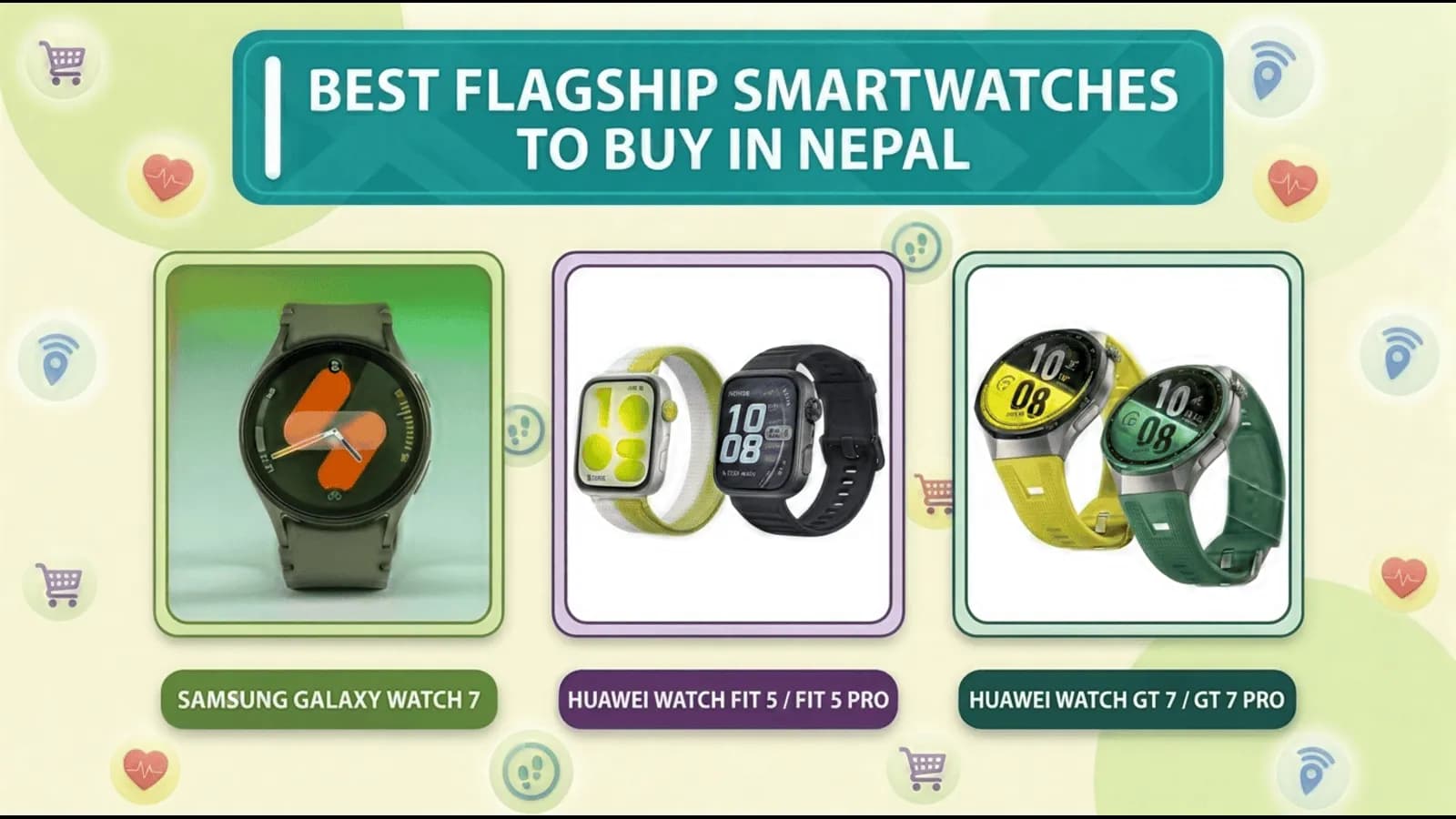
The Galaxy Watch 7 is the best flagship value in Nepal right now, and the Huawei Watch Fit 5 series is the best pick if battery matters more. Here is the table that ranks all seven options by value for money first.
Rank | Watch | Price in Nepal (NPR) | Best for | Main drawback |
1 | 28,500 (40mm), 31,500 (44mm) offer; 44,999 / 49,999 launch | Android users who want apps and a smooth watch | Battery lasts about 1 day | |
2 | 27,990 / 43,990 | Long battery and everyday health tracking | Few third-party apps | |
3 | Huawei Watch GT 7 / GT 7 Pro | 44,990 / 64,990 | Classic round design with up to 21 days of battery | The GT 7 is a small step up from the GT 6 |
4 | 92,500 to 1,15,000 / 76,000 to 83,000 | iPhone users | High price, about 1 to 1.5 days of battery | |
5 | 66,499 (40mm), 71,499 (44mm) | Samsung phone owners who want the newest model | Small upgrade for a big price jump | |
6 | 1,23,499 | Outdoor use, diving, and the longest Samsung battery | Very expensive and large | |
7 | 1,55,000 (Ocean Band), 1,75,000 (Milanese Loop) | iPhone users who want the toughest Apple Watch | Highest price, and satellite features do not work in Nepal |
What Makes a Smartwatch a Flagship, and What Do You Pay Extra For?
A flagship watch costs more because of its materials, sensors, and software. Not because it tells the time better.
In Nepal, that starts at roughly Rs. 28,000 and goes past Rs. 1.5 lakh.
What you pay extra for | What it means in daily use |
Sapphire glass and metal cases | Fewer scratches, so the watch still looks new after a year |
Bright AMOLED display (up to 3,000 nits, and 5,000 on the Ultra 2) | Easy reading in strong sunlight |
Dual-band GPS | Better route tracking for runs and rides |
Extra health sensors (ECG, skin temperature, body composition) | More health data, although some features depend on the region and phone |
Full app store and voice assistant | Spotify, Google services and Gemini on Samsung watches, and Siri on Apple watches |
Bluetooth calling | Answer calls without taking out your phone |
Is the Samsung Galaxy Watch 7 Still the Best Flagship Value in Nepal?
Yes, the Galaxy Watch 7 is the best flagship value in Nepal at the moment. Its official price is Rs. 44,999 for the 40mm and Rs. 49,999 for the 44mm, but an offer currently brings them down to Rs. 28,500 and Rs. 31,500.

At this price, you get a watch with a fast chip, a sapphire display, and a full Wear OS app store.
Samsung Galaxy Watch 7 Key Specs
Spec | Details |
Sizes | 40mm and 44mm, stainless steel frame |
Display | 1.3-inch or 1.5-inch Super AMOLED, sapphire crystal |
Chip and memory | Exynos W1000 (3nm), 2GB RAM, 32GB storage |
Software | Wear OS 5 with One UI Watch 6, 4 years of updates |
Battery | 300mAh (40mm), 425mAh (44mm) |
Durability | 5 ATM, IP68, MIL-STD-810H |
Health | BioActive sensor, ECG, body composition, Energy Score |
GPS | Dual-band GPS |
Price | Rs. 28,500 / 31,500 offer, Rs. 44,999 / 49,999 launch |
How Good Are the Design and Display?
The 44mm Galaxy Watch 7 is 9.7mm thick and weighs about 33g, which is light enough to wear day and night without taking it off.
It also has sapphire crystal glass, 5 ATM water resistance, IP68, and MIL-STD-810H certification, so pool swims and sweaty workouts are fine.
Moreover, the strap is ribbed, quick-drying silicone that is among the best default straps on a smartwatch. And the quick-release button makes it easier to take off.

Talking about the display, the Super AMOLED screen is 480 x 480 pixels at 327 PPI and peaks at 2,000 nits.
While wearing it outdoors, I found it easy to read in the sun, and raise-to-wake was quick enough, so I left the always-on display off.
The weak point is navigation. There is no rotating bezel or crown, and the touch bezel is not reliable for changing volume, especially during a run.
Also, unfortunately for workouts, the stock strap is stiff, so a fabric band will suit fitness better.
How Accurate Are the Health Tracking and GPS?
Health tracking is where the Watch 7 surprised me. Samsung put a new 13-LED BioActive sensor on the back, and during runs, hikes, and table tennis, my heart rate stayed steadier in the hard zones than on older Galaxy Watches.
However, it is not flawless.
Once the watch lost my heart rate mid-workout, probably because I wore it too loose, so wear it fitted.
Another is that the sleep tracking caught even my short naps, and the Energy Score gave me a simple 0 to 100 morning guide built from my sleep and the day before.
While talking GPS, GPS is the one letdown of this watch. This is Samsung's first dual-band watch, so I expected great routes, but on one walk, the line cut through buildings, even in fairly open areas.
On other runs and rides, it locked on within about 10 seconds and auto-pause worked well.
So I treat it as great for training logs and less so for exact maps. Strength training also feels unfinished, since you enter reps and sets by hand in this watch.
In Nepal, remember that sleep apnea detection does not work on this watch. Also, ECG and blood pressure need a Samsung phone and the Samsung Health Monitor app, and the AGEs Index is still experimental with no clear advice.
Samsung Galaxy Watch 7 Pros and Cons
Pros | Cons |
Fast and smooth, with no lag in daily use | Battery lasts about 1 day, and the 40mm lasts around 30 hours |
Bright, sharp display with sapphire glass | Dual-band GPS can still be off in busy areas |
Full app store, including Spotify and Google apps | Sleep apnea detection is not available in Nepal |
Energy Score and sleep tracking are useful | Many health features need a Samsung phone |
Large discount over the launch price | No physical rotating bezel |
Who should buy it: Buy the Galaxy Watch 7 if you use an Android phone, especially a Samsung one, and want the best flagship for the least money.
Skip it if you want a multi-day battery. Moreover, check that the offer price is still running before you pay, because the launch price is much higher.
Huawei Watch Fit 5 or the Fit 5 Pro
For most people, the regular Watch Fit 5 at Rs. 27,990 is the smarter buy, and the Fit 5 Pro at Rs. 43,990 is worth it only if you want ECG, sapphire glass, and outdoor tools.
Both give you about a week of battery, which is rare among flagship watches.
Huawei Watch Fit 5 and Fit 5 Pro Key Specs
Spec | Watch Fit 5 | Watch Fit 5 Pro |
Price in Nepal | Rs. 27,990 | Rs. 43,990 (free Huawei FreeBuds SE 2) |
Display | 1.82-inch AMOLED, 2,500 nits | 1.92-inch LTPO AMOLED, 3,000 nits |
Glass and build | Standard glass, aluminium body | 2.5D sapphire glass, titanium bezel |
Weight | 27g | 30.4g |
Battery | 471mAh, about 7 to 8 days without always-on display | 471mAh, about 7 to 8 days without always-on display |
GPS | Dual-band, five systems | Dual-band, five systems |
ECG | No | Yes (not officially supported in Nepal) |
Extras | 100+ sports modes, 5 ATM | Skin temperature, golf maps, freediving to 40m |
Software | HarmonyOS | HarmonyOS |
How Good Are the Design and Display?
The Watch Fit 5 disappears on your wrist. It weighs 27g and is only 9.5mm thick, and I was comfortable wearing it through the night.

The 1.82-inch AMOLED screen reaches 2,500 nits, and a rotating crown plus a side button keep control easy. It comes in black, white, green, purple, and silver, with 5 ATM water resistance and IP6X dust protection.
One handy tip is that Huawei suggests the fluoroelastomer strap for swimming and hard workouts, while the lighter nylon strap suits daily wear.
You will feel the Fit 5 Pro is like a step up the moment you look at the screen. It is bigger (1.92 inches) with LTPO AMOLED, and peaks near 3,000 nits, so I could read it clearly in midday sun.

LTPO also lets the always-on display slow to about 1Hz, which saves power.
The build is tougher too, with sapphire glass over a titanium bezel, and the white model adds a micro-arc oxidation coating.
After two weeks of rough use, I found no marks on the glass.
How Accurate Are the Health Tracking and GPS?
Here is the surprising part: the Pro does not track better than the standard Fit 5. I tested both against reference devices, and they scored the same. Against a Polar H10 chest strap, the Fit 5 matched almost perfectly in indoor cycling (a correlation of 0.99, where 1.0 is perfect) and stayed strong in running and outdoor cycling at 0.96.
That gives a heart rate score of 97 out of 100. Weightlifting is the exception at 0.94 because wrist tension makes the sensor miss peaks during sets, so use a chest strap if you lift.
Moreover, Sleep tracking is more average. Against a Zmax EEG headband, deep sleep matched about 80% of the time and light sleep about 78%, but REM matched only 23%. That gives a sleep score of 60 out of 100, which is okay, and Huawei says its own tests show better REM results.
On the other hand, GPS did better. I cycled the same commute three times each way and ran a loop twice. Signals locked fast and overlapped well, with small drift near a roundabout and beside a large wall, so I score it 77, which is good.
Only the Pro has ECG and arterial stiffness checks, and ECG is not officially supported in Nepal.

What Smart Features Does It Offer?
Think of these as fitness watches with a lean, simple side. They run Huawei's own system, not Wear OS, so there is no Play Store, and the voice assistant is closer to a basic Siri than to Gemini. Notifications show a summary, and replies are limited.
Still, the built-in apps cover the basics, including a compass, a barometer, offline maps, and a voice recorder. Auto-tracking also works well. After about 10 minutes of walking or running, it offers to record the workout and logs it from the very start, and it worked reliably for me.
Also, the Fit 5 adds 30 guided mini workouts for the neck, shoulders, core, and legs, and a panda watch face that gets more lively as you move.
The Pro goes further with golf maps, racket sports, a cycling mode with fall detection, and freediving to 40m.
How Long Does the Battery Last?
Huawei is known for battery life, and the Fit 5 series delivers. Both watches have a 471mAh battery, and Huawei claims 10 days of light use, 7 days of typical use, and 4 days with the always-on display.
When I switched on everything on the Pro, including the always-on display, 24-hour tracking, and sleep tracking, I still got about 4.5 days.
With calls and notifications, I got 5 to 6 days. In normal use without the always-on display, you can expect around a week.
One catch is that reverse wireless charging from a phone did not work reliably on several phones, so pack the charging dock when you travel.
Huawei Watch Fit 5 Series Pros and Cons
Pros | Cons |
About a week of real battery life | Limited third-party apps and no Gemini or Spotify app |
Bright, smooth AMOLED display | ECG on the Pro is not officially supported in Nepal |
Strong GPS and 100+ workout modes | Huawei Health setup takes extra steps on Android |
Light at 27g, so easy to wear for sleep tracking | Proprietary straps only |
The Pro adds sapphire glass and steadier heart-rate tracking | The Pro costs Rs. 16,000 more |
Who should buy it: Buy the Fit 5 if you want reliable health tracking and a long battery without paying Pro prices. Choose the Fit 5 Pro if you hike, run trails, or want ECG, and you accept that ECG needs a regional workaround in Nepal. Additionally, skip both if you want a full app store, because Huawei's app list is short.
Is the Huawei Watch GT 7 or GT 7 Pro Worth the Money in Nepal?
The GT 7 at Rs. 44,990 is a good first flagship for anyone who wants a round, classic watch with up to 21 days of battery. The GT 7 Pro at Rs. 64,990 adds titanium, sapphire glass, dual-band GPS, and ECG, but it costs Rs. 20,000 more.

Huawei Watch GT 7 and GT 7 Pro Key Specs
Spec | Watch GT 7 (46mm) | Watch GT 7 Pro |
Price in Nepal | Rs. 44,990 | Rs. 64,990 (free Huawei FreeBuds SE 2) |
Display | 1.47-inch AMOLED, 466 x 466, 3,000 nits | 1.47-inch AMOLED, 466 x 466, 3,000 nits |
Build | Metal body, 51.3g | Titanium front, nano-ceramic back, sapphire glass, 55.5g |
Battery | Up to 21 days light use, 12 days typical | Up to 21 days light use, 12 days typical, 7 days with always-on display |
GPS | Built-in GNSS | Dual-band GPS with five systems |
Health | Heart rate, SpO2, sleep, stress, skin temperature | Adds ECG and the TruSense system |
Durability | 5 ATM, IP69 | 5 ATM, IP69, freediving to 40m |
Sports | 110+ modes | 100+ modes, Pro Ski mode, 51 hours of trail running |
How Good Are the Design and Display?
The GT 7 looks like a real watch first and a smartwatch second. The 46mm model has a classic round stainless steel case that is 10.95mm thick and about 51g without the strap, with 5 ATM and IP69 protection.
I have used GT watches for years, and the GT 7 feels almost the same as the GT 6, down to the 1.47-inch, 466 x 466 AMOLED screen, which still peaks at 3,000 nits and looks vibrant outdoors. The new easy cross strap is a nice touch, because it tucks the loose end underneath, so it lies flat and stays put during sports.
The GT 7 Pro goes in a sportier direction, with an aerospace-grade titanium case, a ceramic bezel, sapphire glass, and a super-hard coating on the case.
Next to the Apple Watch Series 11, the 46mm Pro looks bigger on the wrist, so check the size if you have a small wrist. In Nepal, only the 46mm GT 7 is sold, so the smaller 41mm is not an option.
How Accurate Are the Health Tracking and GPS?
In a side-by-side run, the GT 7 Pro's heart rate stayed very close to a Polar H10 chest strap from rest through the run and the cool-down.
Both watches use the TruSeen sensor system for heart rate, blood oxygen, HRV, stress, and sleep, and TruSleep 5.0 adds sleep stages, quality, and recovery. I found the readiness score really fun.
Moreover, features differ by model, so read this part carefully. Compared with the Apple Watch Series 11, only the GT 7 Pro and the Apple Watch have ECG. Only the Pro has arterial stiffness checks and a coronary heart disease risk study, while both GT 7 models have the diabetes risk study.
Huawei calls these screening tools, not diagnoses, and ECG is not officially supported in Nepal, so confirm what works before paying for the Pro.
GPS is smart here in this watch. The GT 7 uses sunflower positioning, and the Pro adds AI XDR positioning, which combines satellite data with onboard sensors and rebuilds your route through tunnels and dead zones.
During a run in a basement parking lot, I saw a "positioning signal weak" alert, but tracking kept going.
While on a run, the Pro also logged cadence, power, ground contact time, vertical oscillation, balance, and altitude, while the Apple Watch Series 11 did not show balance or altitude.
What Smart Features Does It Offer?
This series is built for people who train. The Pro can act as a bike computer. It connects to power meters and gives turn-by-turn directions, sharp-turn alerts, and climb planning with distance and gradient.
Trail runners get offline maps, GPX import and a route-back feature that syncs to Strava, and there is golf mode, skiing, freediving to 40m and racket sports through subscription-free apps.
Moreover, AI running plans build easy, tempo, long, and interval sessions, and the Huawei Health app turns each run into written tips on your form, which replaced a paid Strava feature for me.
The Pro can also share your health data with family through the Health community. On the downside, the app library is smaller than on Wear OS or watchOS, and if you already own a GT 5 or GT 6, I see little reason to upgrade to the GT 7.
How Long Does the Battery Last?
Battery is the headline strength, and it really is impressive. Huawei rates the 46mm GT 7 and the GT 7 Pro for up to 21 days of light use, 12 days of typical use, and about 7 days with the always-on display.
The Pro lasts up to 44 hours of cycling tracking and 51 hours of trail running. On a two-week trip, I forgot my charger and the watch still had power left, which beat the 21-day claim. So if you hate daily charging, this series is your best choice in this guide.
Huawei Watch GT 7 Series Pros and Cons
Pros | Cons |
Battery lasts one to three weeks | The GT 7 looks and feels very similar to the GT 6 |
Premium round design with a bright display | Fewer apps than Wear OS or watchOS |
Strong sports tracking, with AI running plans | ECG and some heart tools may not work officially in Nepal |
Works with both Android and iPhone | The Pro costs Rs. 20,000 more than the GT 7 |
Free earbuds with the Pro | Only the 46mm GT 7 is sold in Nepal |
Who should buy it: Buy the GT 7 if you are new to Huawei and want weeks of battery in a classic round case. Choose the GT 7 Pro if you want a rugged titanium watch for hiking, skiing, or diving. However, if you already own a GT 5 or GT 6, there is little reason to upgrade.
Apple Watch Series 11/12
Choose the Series 11 only if it saves you about Rs. 15,000 to Rs. 20,000 over the Series 12; otherwise, buy the Series 12.

Both need an iPhone, and both give you the smoothest watch software and the best health tracking in this price range.

Apple Watch Series 12 and Series 11 Key Specs
Spec | Series 12 | Series 11 |
Price in Nepal | Rs. 92,500 (42mm, Sports Band) to Rs. 1,15,000 (46mm, Milanese Loop) | Rs. 76,000 (42mm), Rs. 83,000 (46mm) |
Sizes | 42mm and 46mm | 42mm and 46mm |
Case | Aluminium, titanium or ceramic | Aluminium (titanium also sold abroad) |
Display | 1.96-inch LTPO3 OLED, 2,000 nits | 1.89-inch or 2.04-inch LTPO3 OLED, 2,000 nits |
Chip | Apple S11, 64GB | Apple S10, 64GB |
Battery | Up to 24 hours claimed, 1 to 1.5 days in real use, 38 hours in low power mode | Up to 24 hours, 38 hours in low power mode |
Charging | 80% in 30 minutes, up to 12 hours of use from a 15-minute charge | 80% in 30 minutes, 8 hours from a 15-minute charge |
Health | ECG, sleep score, sleep apnea notifications, Vitals with HRV, Readiness score, hypertension notifications | ECG, sleep score, sleep apnea notifications, hypertension notifications |
Water resistance | 50m, IP6X | 50m, IP6X |
How Good Are the Design and Display?
From the outside, I could not tell the Series 12 from the Series 11 across a room. Both are just under 1cm thin, come in 42mm and 46mm, and have a bright always-on LTPO3 OLED display with up to 2,000 nits.

The Series 12 case is only a tiny bit larger. The real change is the glass. On aluminium models, the Series 12 uses Ceramic Shield 2, which Apple says is about 60% tougher than the Series 11 glass, and that glass was already twice as scratch-resistant as the Series 10.
Moreover, titanium and ceramic models use sapphire crystal, which is even stronger.
How Accurate Are the Health Tracking and GPS?
The big story is the new heart-rate sensor. It reads your heart rate every 5 seconds instead of every 5 minutes, and it tracks HRV (heart rate variability) all night and through the day. The Vitals app needs 7 days of wear to learn your baseline.
Against chest straps, I found it quite good, even on runs and rides. However, the catch is that it skips readings when it is not confident, leaving gaps of 5 to 18 seconds. Apple's own accuracy study did not count those gaps.
The Readiness score runs from 0 to 10 and updates throughout the day to show how ready your body is for exercise. On my test day, it started at 8 and fell to 3 after a hard workout.
However, I found it too odd, because it rarely gave a very low score like 1 or 2. Both watches also give a sleep score, ECG, and hypertension alerts. The hypertension alert needs about 30 days of data before it can warn you.
GPS is single-band on both, so it is good but not great. In Nepal, the Series 11 is GPS-only, and Apple's satellite features do not work here.
What Smart Features Does It Offer?
Both watches run watchOS 26 with the Liquid Glass look. It looks lovely, but the lower contrast makes some faces harder to read.
You also get a Notes app, call screening, a double tap gesture, a wrist flick to go back, and Siri when you raise your wrist to speak.
Workout Buddy here gives you spoken coaching, but it needs an iPhone with Apple Intelligence.
On the other hand, the microphones are a real strength, because on a call in a loud stadium, the other person heard me clearly.
Of course, none of this works without an iPhone.

How Long Does the Battery Last?
Apple claims up to 24 hours and 38 hours in low power mode, up from 18 hours on the Series 10, and my results mostly agree.
My Series 11 lasted 27 hours before it hit 1%. On the Series 12, with every feature switched on, I had 86% after a full night of sleep tracking, used a little over half the battery in 24 hours and reached 4% after about 45 hours in full power mode.
So plan to charge every day or two.
The bigger win is charging speed. Both reach 80% in 30 minutes, and a 15-minute top-up gives about 8 hours on the Series 11 and up to 12 hours on the Series 12.
Just 5 minutes gives about 10 hours of sleep tracking, so a quick charge before bed is enough.
Apple Watch Series 12 and Series 11 Pros and Cons
Pros | Cons |
Smoothest software and best app support | Works only with an iPhone |
Accurate heart-rate and sleep tracking | Battery lasts about 1 to 1.5 days |
Fast charging | Very high price in Nepal |
Scratch-resistant glass, twice as tough as the Series 10 | GPS is single-band, so it is good but not great, and the Series 12 is a small upgrade over the Series 11 |
Series 12 adds a new heart-rate sensor that reads every 5 seconds, a Readiness score, and tougher Ceramic Shield 2 glass | Nepal models of the Series 11 are GPS-only, with no cellular |
Who should buy it: Buy an Apple Watch if you use an iPhone, because it works best there. Pick the Series 12 for the newer chip and the ceramic option. Pick the Series 11 only when the price gap is large.
Meanwhile, if you own a Series 11, skip the upgrade. If you own a Series 10 or older, the new heart-rate sensor and Readiness score are good reasons to move up.
Additionally, check stock before you pay, since the Series 11 is marked discontinued at some shops.
Samsung Galaxy Watch 9
The Galaxy Watch 9 is very good, but it has only a small upgrade over the Galaxy Watch 7.

So, most buyers should pick the Galaxy Watch 7 at the offer price instead. It costs Rs. 66,499 for the 40mm and Rs. 71,499 for the 44mm, which is more than double the Watch 7 offer.
Samsung Galaxy Watch 9 Key Specs
Spec | Details |
Sizes | 40mm and 44mm, Armor Aluminum 2 frame |
Display | 1.34-inch or 1.47-inch Super AMOLED, up to 3,000 nits, sapphire crystal |
Chip and memory | Snapdragon Wear Elite (3nm), 2GB RAM, 32GB storage |
Software | Wear OS 7 with One UI 9 Watch |
Battery | 390mAh (40mm), 445mAh (44mm), about 1 to 1.5 days in real use |
GPS | Dual-band GPS (L1 + L5) |
Health | ECG, SpO2, skin temperature, Vitals, Cardio Load, Antioxidant Index |
Connectivity | Bluetooth 6.0, Wi-Fi, NFC (Bluetooth-only models in Nepal, no LTE) |
Price | Rs. 66,499 (40mm), Rs. 71,499 (44mm) |
How Good Are the Design and Display?
The Galaxy Watch 9 is slim (8.6mm) and light, at 31.5g in 40mm and 34g in 44mm, with an Armor Aluminum 2 frame, sapphire crystal glass, 5 ATM, and IP68.
After wearing the Ultra, switching to this felt like a relief, because it slides under my sleeves and I forget it is on my hand.
For the screen, you get a 1.34-inch screen on the 40mm and a 1.47-inch screen on the 44mm, and both reach 3,000 nits. I could read them clearly in bright sun, and the touch felt quick and smooth.
However, there are a few small annoyances. The squircle shape divides opinion, but in my opinion, the corners waste screen space.
Also, there is also no rotating bezel or crown, so the digital bezel makes your finger cover the screen as you scroll.
Moreover, Samsung's own strap lock limits third-party straps, too. The silicone Sport Band irritated my skin for the first few days, so pick the fabric band if you have sensitive skin.
How Accurate Are the Health Tracking and GPS?
Sleep tracking is the highlight. It splits your night into deep, REM, and light sleep, and the numbers looked accurate to me. One night showed about 109 minutes of deep sleep and 97 minutes of REM. My sleep score of 91 matched how I felt, and the sleep data is easy to read.
Furthermore, Heart rate was weak for the first 3 to 4 minutes of a run, compared with a Polar H10 chest strap. After that, it followed sudden changes in pace almost perfectly. Body fat readings were less steady, ranging from 12% to 21% over a month against 11% to 15% on a Withings scale, so use them for trends only.
GPS needs care on this watch. Among tall buildings, the route drifted off the sidewalk and cut corners, even with dual-band GPS. In open areas, along a river trail and under a bridge, it was accurate.
Hence, Samsung Health also adds Vitals, Vascular Load, Cardio Load, a Fitness Index, and a hearing-damage alert.
What Smart Features Does It Offer?
The smart features are the best part of this watch. It runs Wear OS 7 with One UI 9 Watch, so you get Spotify and Google apps right on your wrist. I also liked the tile stacks because I could group the things I check most, like weather, music, and my daily activity, and reach them with one swipe.
Gemini is the feature I used most. I long-pressed the top button and asked it to set alarms, add calendar entries and answer quick questions, and it handled all three without me touching the screen.
So, the new Snapdragon Wear Elite chip keeps everything smooth, although the speed gain over last year's model is small.
There are a few small downsides also. The Samsung Health home screen shows an ad for a more expensive watch, and you cannot create watch faces with AI. In Nepal, only the Bluetooth model is sold, so LTE calling is not available.
On the positive side, Samsung promises 5 years of OS and security updates, so the software should stay fresh for a long time.
How Long Does the Battery Last?
The battery is 390mAh on the 40mm and 445mAh on the 44mm, and Samsung claims up to 40 hours with the always-on display off.
With it off, I got almost two days. With every feature switched on, I expected about a day and a half, compared to 2.5 to 3 days on the Ultra 2.
Charging is slow compared with the Pixel Watch and Ultra. So the Watch 9 is a small upgrade over the Watch 7, and it is worth the extra money only if you want the newest chip and the longer update promise.
Samsung Galaxy Watch 9 Pros and Cons
Pros | Cons |
Excellent sleep tracking, and accurate heart rate once it locks on | Battery lasts about 1 to 1.5 days, even with the bigger cell |
Bright display and smooth performance | Very small upgrade over the Galaxy Watch 8 |
Faster GPS lock than the Watch 8 | Charging is slow, and GPS can drift between tall buildings |
Mature Wear OS with Gemini and full apps | Many health features need a Samsung phone |
Same price as last year's model at launch | Trail Run and rugged tools are kept for the Ultra 2 |
Who should buy it: Buy the Galaxy Watch 9 if you want the newest Samsung watch and the price gap to older models is small. Otherwise, the Galaxy Watch 7 at its offer price, or the Galaxy Watch 8 at a 25 to 30 percent discount, gives you nearly the same experience for much less.
Galaxy Watch Ultra 2
Is it Worth 1.2 Lakh Rupees?
Only if you use a Samsung phone and you dive, hike or train hard. For everyone else, it is overkill, because cheaper watches in this guide cover daily use just as well.

Galaxy Watch Ultra 2 Key Specs
Spec | Galaxy Watch Ultra 2 |
Price in Nepal | Rs. 1,23,499 |
Case | 47mm titanium, 61.5g |
Display | 1.52-inch Super AMOLED, up to 5,000 nits |
Chip and storage | Snapdragon Wear Elite, 64GB |
Battery | 800mAh, 3 to 4 days in real use |
Durability | 10 ATM, IP69K, dive-rated to 40m |
GPS | Dual-band GPS |
Phone | Android (Samsung phone for full features) |
Extras | Safety siren, trail run tools, 5 years of updates |
How Good Are the Design and Display?
The Galaxy Watch Ultra 2 is a big watch, with a 47mm Grade 4 titanium case (47.4 x 47.1 x 10.7mm) that weighs 61.5g. I will warn you that it looks comical on small wrists, and the squircle shape makes it look bulkier.
Even so, I stopped noticing the weight by day 2, because the case is 12% thinner and the Marine band is about 26% lighter than before.
Also, it has 10 ATM, IP69K, MIL-STD-810H, and EN13319 dive certification. The one miss is that there is still no rotating bezel, and the touchscreen registers erratic touches when your fingers or the screen are wet.

However, the 1.52-inch Super AMOLED screen reaches 5,000 nits, so I could read it easily in harsh sun. It also has sapphire glass and very crisp haptics.
How Accurate Are the Health Tracking and GPS?
The Ultra 2 has dual-band GPS (L1 and L5) and adds outdoor tools that the regular Galaxy Watch lacks. These include GPX route following with turn-by-turn directions, climb guidance, a dive depth app for recreational diving to 40m, and an 86-decibel siren that carries up to 180 metres.
It also has the second-generation BioActive sensor with Vitals, Cardio Load, a Heart Health Score and a Fitness Index.
Moreover, Blood Pressure Trend needs periodic calibration with a cuff, and features such as Energy Score and AGEs need a Samsung phone. In Nepal, check which health features are active before you buy.
What Smart Features Does It Offer?
The Ultra 2 runs Wear OS 7 with One UI 9 Watch on the Snapdragon Wear Elite chip (one 2.1GHz core and four 1.9GHz cores), with 2GB of RAM and 64GB of storage.
It felt very fast in daily use. And you can talk to Gemini just by raising your wrist, with no wake word, though it sometimes did not respond for me. Moreover, you can also double-pinch to accept a call and shake to decline on this watch.
Lastly, it is the first time that Samsung promises 5 years of updates for a smartwatch.
How Long Does the Battery Last?
The Ultra 2 has an 800mAh battery, the largest ever on a Galaxy Watch.
With every health feature switched on, about 15,000 steps and about two hours of GPS daily, I got 3 to 4 days of battery backup.
However, Samsung quotes up to 60 hours with the always-on display on, and 80 hours with it off.
Lastly, talking about charging, it offers fast charging, giving about 40% in 30 minutes. However, a full charge takes just under 2 hours, and you can charge only with the puck.
Galaxy Watch Ultra 2 Pros and Cons
Pros | Cons |
| Very bright 1.52-inch screen that reaches 5,000 nits, with sapphire glass | Costs Rs. 1,23,499, one of the highest prices in this guide |
| Battery lasts 3 to 4 days in real use, the best on a Samsung watch | Large 47mm case that looks bulky on small wrists |
| Tough build with a titanium case, 10 ATM, IP69K, MIL-STD-810H and dive rating to 40m | No rotating bezel, and the touchscreen can act up when wet |
| Dual-band GPS with GPX route following, climb guidance and an 86-decibel siren | Charges only with its puck, and the straps are proprietary |
| Strong health tracking, including Vitals, Cardio Load and a Heart Health Score | Blood Pressure Trend needs cuff calibration, and some features need a Samsung phone |
| Gemini works by raising your wrist, with 5 years of updates promised | Gemini did not always respond for me |
Who should buy them: Buy the Galaxy Watch Ultra 2 if you use a Samsung phone and need a watch for diving, trails, or multi-day trips. Otherwise, the Galaxy Watch 7 or the Galaxy Watch 9 will serve you better for much less.
Apple Watch Ultra 3
Is it Worth Rs. 1.5 Lakh or More?
Only if you use an iPhone and need a watch that can handle diving, long hikes, or hard training.
The Ultra 3 is the toughest Apple Watch in this guide, with a titanium case, a large, bright screen, and the longest battery Apple offers.
However, it costs Rs. 1.55 lakh or more, and for daily use, the Apple Watch Series 12 does nearly the same job for much less.

Apple Watch Ultra 3 Key Specs
Spec | Apple Watch Ultra 3 |
Price in Nepal | Rs. 1,55,000 (Ocean Band), Rs. 1,75,000 (Milanese Loop) |
Case | 49mm titanium, about 61g |
Display | 2.04-inch LTPO3 OLED, up to 3,000 nits |
Chip and storage | Apple S10, 64GB |
Battery | 42 hours regular use, 72 hours in low power mode |
Durability | 100m water resistance, dive-rated to 40m |
GPS | Dual-band GPS |
Phone | iPhone only |
Extras | Satellite SOS (not working in Nepal), 5G |
How Good Are the Design and Display?
The Apple Watch Ultra 3 has a 49mm Grade 5 titanium case that weighs about 61g, with 100m water resistance, EN13319 dive certification, and sapphire glass.
Furthermore, the LTPO3 screen measures 2.04 inches (422 x 514 pixels), with thin bezels, and it reaches up to 3,000 nits.
How Accurate Are the Health Tracking and GPS?
It has dual-band GPS (L1 and L5), and on my outdoor runs and rides, it locked on quickly. Heart rate was the highlight, because in my running and cycling tests the readings were very accurate, off by only about 1 beat per minute.
It also offers ECG, blood oxygen, a sleep score, and hypertension notifications, and the sleep score was easy to read each morning.
However, all of it needs an iPhone, and moreover, Apple's satellite features do not work in Nepal, so do not pay extra for them.
What Smart Features Does It Offer?
The Ultra 3 runs watchOS 26 on the S10 chip, with 64GB of storage and 5G RedCap on cellular models. The chip is not new, so this is a small upgrade over Apple's earlier Ultra.
Moreover, it adds Workout Buddy coaching, and obviously Apple's app support is still the strongest on this model.
How Long Does the Battery Last?
Apple rates the Ultra 3 for about 42 hours in regular use.
In practice, that means a full day and a night of sleep tracking, with enough left to start the next morning. I still ended up charging it every second day, so it is not a week-long watch.
However, if you are heading out for a long hike or a trip, low power mode stretches the battery to about 72 hours. You lose a few background features, but the basics keep working in this mode.
Another thing on this watch is that, when the battery does run low, charging is quick. It reaches 80% in about 45 minutes, so a short top-up while you get ready is usually enough.
Apple Watch Ultra 3 Pros and Cons
Pros | Cons |
Rugged 49mm Grade 5 titanium case with sapphire glass and 100m water resistance | Costs Rs. 1,55,000 to Rs. 1,75,000, the highest price in this guide |
Large 2.04-inch screen that reaches 3,000 nits and dims to 1 nit at night | Big on the wrist, even though the weight fades after a few days |
Battery lasts about 42 hours, or 72 hours in low power mode, and charges to 80% in 45 minutes | Still needs charging every second day, so it is not a week-long watch |
Very accurate heart rate, off by only about 1 beat per minute in my tests | Runs the S10 chip, so it is a small upgrade over Apple's earlier Ultra |
ECG, blood oxygen, sleep score and hypertension notifications | Satellite features do not work in Nepal |
Best app support, plus Workout Buddy coaching and 5G on cellular models | Works with iPhone only |
Who should buy it: Buy the Apple Watch Ultra 3 if you use an iPhone and want the toughest Apple Watch.
Otherwise, the Apple Watch Series 12 will serve you better for much less.
Additionally, Apple has launched a newer Ultra 4 abroad, so confirm what is on sale in Nepal before you pay for the Ultra 3.
How Do You Choose the Right Flagship Smartwatch in Nepal?
Your phone decides most of this. Pick the watch that fits your phone first, and only then compare battery and toughness. After testing all of these, I found that most people end up in one of the eight situations below.
If this is you | Buy this | What I found |
You use Android and want the best value | Samsung Galaxy Watch 7 | Apps open fast and it does nearly everything the newer Samsung watches do, at the lowest price here when the offer is on |
You hate charging every night | Huawei Watch Fit 5 | I got around 7 to 8 days of real use for Rs. 27,990 |
You want weeks of battery in a round case | Huawei Watch GT 7 | Up to 21 days on light use, so I rarely thought about the charger |
You hike or freedive and use Huawei | Huawei Watch GT 7 Pro or Fit 5 Pro | Titanium, sapphire glass and 40m freediving support |
You use an iPhone | Apple Watch Series 12 | The smoothest software and the best health tracking of any watch here |
You want the newest Samsung watch | Galaxy Watch 9 | A newer chip and a faster GPS lock, but the daily experience is close to the Watch 7 |
You need a rugged Android watch that lasts 3 to 4 days | Galaxy Watch Ultra 2 | The biggest battery on a Galaxy Watch and a 5,000-nit screen I could read in harsh sun |
You need the toughest Apple Watch | Apple Watch Ultra 3 | A titanium build and 72 hours in low power mode, but only worth it if you dive or hike hard |
Which Flagship Smartwatch Should You Buy at Your Budget?
Under Rs. 35,000, I would buy the Galaxy Watch 7 or the Huawei Watch Fit 5, because both feel far more expensive than they are.
Above that, your phone decides the pick, and each step up in price buys you something specific.
Budget (NPR) | Best pick | Runner-up | What the extra money buys |
Up to 35,000 | Samsung Galaxy Watch 7 (offer price) | Huawei Watch Fit 5 | Fast apps on the Samsung, or about 7 to 8 days of battery on the Huawei |
35,000 to 50,000 | Huawei Watch GT 7 | Huawei Watch Fit 5 Pro | Up to 21 days of battery on the GT 7, or titanium and freediving support on the Fit 5 Pro |
50,000 to 80,000 | Apple Watch Series 11 (iPhone) or Galaxy Watch 9 (Samsung) | Huawei Watch GT 7 Pro | The best iPhone value, or the newest Samsung software with a faster GPS lock |
80,000 to 1,20,000 | Apple Watch Series 12 | Apple Watch Series 11 (46mm) | The smoothest software and the best health tracking for an iPhone |
Above 1,20,000 | Galaxy Watch Ultra 2 (Android) or Apple Watch Ultra 3 (iPhone) | Apple Watch Series 12 (46mm, Milanese Loop) | Titanium toughness and dive-ready builds, which only suit hikers and divers |
Conclusion: Which Flagship Smartwatch Should You Buy in Nepal?
So, if I want one flagship watch in Nepal, I would buy the Samsung Galaxy Watch 7 at its offer price of about Rs. 28,500. It is fast, the display is bright, and you get a full app store, and most importantly, it covers what most people need for a fraction of the price of the newer models.
However, your phone and your habits can change that answer.
If battery matters more than apps, the Huawei Watch Fit 5 or GT 7 will last a week or longer, and it will be a perfect option for you.
If you use an iPhone, the Apple Watch Series 12 is the clear choice, because the Android watches in this guide do not work with it.
The Galaxy Watch 9, Galaxy Watch Ultra 2 and Apple Watch Ultra 3 make sense only if you want the newest Samsung model or need extra toughness for diving and extra outdoor activity.
For daily use, the cheaper watches do nearly the same job.
Before you pay: Confirm the exact price, the offer end date, and the warranty with the shop, because flagship prices and offers in Nepal change often.
Next, check your phone, since Apple watches need an iPhone and many Samsung health features need a Samsung phone.
Additionally, remember that Huawei's ECG and a few other health tools are not officially supported in Nepal. And the Galaxy Watch 9 is Bluetooth-only, and Apple's satellite features do not work.
Frequently Asked Questions
Which is the best flagship smartwatch in Nepal?
The Samsung Galaxy Watch 7 is the best flagship value, and the Huawei Watch Fit 5 is the best for battery. If you use an iPhone, the Apple Watch Series 12 is the best fit.
Which flagship smartwatch has the longest battery life?
The Huawei Watch GT 7 and GT 7 Pro last up to 21 days on light use and about 12 days on typical use. Among Samsung and Apple watches, the Galaxy Watch Ultra 2 lasts 3 to 4 days, and the Apple Watch Ultra 3 offers up to 72 hours in low power mode.
Is the Galaxy Watch 9 better than the Galaxy Watch 7?
The Galaxy Watch 9 has a faster chip, a bigger battery, and a quicker GPS lock. However, the experience is very close, and the battery still lasts only about one to one and a half days. Therefore, the Galaxy Watch 7 at Rs. 28,500 is the better buy for most people.
Does ECG work on Huawei watches in Nepal?
Not officially. Huawei lists ECG on the Fit 5 Pro and GT 7 Pro, but it is not officially supported in Nepal. Some users set the Huawei Health region to Singapore to turn it on, although this is a workaround and may change with updates.
Can you use an Apple Watch with an Android phone?
No. Apple Watches need an iPhone to set up and work. Android users should look at the Galaxy Watch 7, Galaxy Watch 9, or a Huawei watch instead.
Do the Apple Watch Ultra 3 satellite features work in Nepal?
No. Satellite SOS and messaging do not work in Nepal, so the Ultra 3 is mainly worth it for its battery and rugged build.
Are Samsung health features limited on non-Samsung phones?
Yes. Features such as Energy Score, blood pressure, and some heart tools need a Samsung phone and a Samsung account. The watch still works with other Android phones, but you lose part of the health suite.