

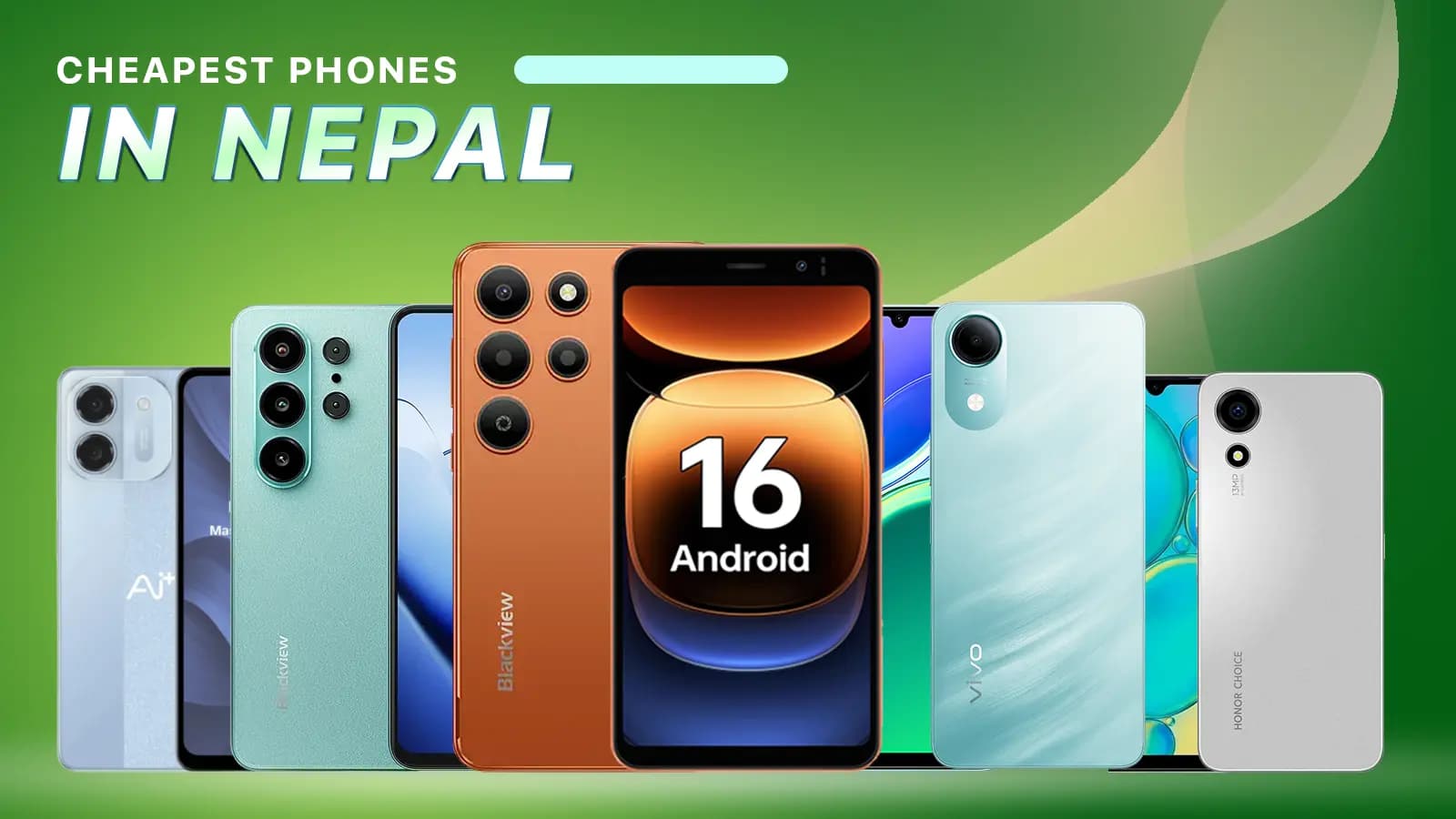
Cheap Android Phone in Nepal at a Glance
| Phone | Key Strength | Main Compromises |
| Blackview Wave 2C — Rs. 9,999 (3/32GB) | Lowest price, Android 16 Go software, microSD slot | Small 5-inch low-res screen, basic camera, small battery |
| Blackview Wave 10C — Rs. 13,999 (4/32GB) | Massive 6.88-inch display, 5,000mAh battery | HD+ display, 205 gm weight, basic cameras |
| Honor Choice T10 — Rs. 16,499 (3/32GB) | Good durability, AI features, 5,000mAh battery | Slow 10W charging; base model only has 3GB RAM |
| Vivo Y05e — Rs. 19,999 (4/64GB) | Brightest screen, IP64 rating, 15W charging | Only 8MP rear camera |
| Ai+ Pulse 2 — Rs. 19,999 (4/64GB) | Large 6,000mAh battery, 120Hz display, 50MP camer | Slow 10W charging |
Blackview Wave 2C: The Cheapest Android Phone in Nepal Right Now
I’ve handled dozens of budget devices over the years, but the Blackview Wave 2C genuinely stood out to me simply because of its sheer accessibility and nostalgic form factor. It has a compact 5-inch screen and weighs just 158.5g, so it slips into a pocket easily and is comfortable to use with one hand. It runs Android 16 Go, a lighter version of Android built for phones with modest memory, which is an excellent call at this price.

The Wave 2C is not a powerhouse by any stretch of the imagination, but it serves a very specific, practical purpose for buyers who just need a working smartphone without breaking the bank. I found it to be perfectly adequate for staying online, though the Wave 2C definitely requires a bit of patience when switching between heavy apps. You get dual-SIM 4G, a microSD slot for extra storage, a headphone jack, and even FM radio. What you don’t get is a big, sharp display or a big battery, and you’ll notice that quickly.
Blackview Wave 2C Price and Specifications:
- Display: 5” IPS LCD panel, 480 x 854 pixels, 60Hz refresh rate, 400 nits brightness
- Processor: Unisoc SC9863A1 (28nm)
- RAM / Storage: 3GB RAM, 32GB storage
- Rear Camera: 5MP f/2.4
- Front Camera: 2MP f/2.8
- Battery and Charging: 3,000 mAh with 5W charging
- Network: 4G LTE
- Software: Android 16 (Go Edition)
What You Get and What You Give Up
What you get: You get a highly portable, pocketable device that handles the absolute essentials beautifully. The Android 16 Go Edition is specifically optimized for low-RAM devices, while it also brings dual 4G connectivity, a headphone jack, and FM radio. It is perfect for keeping in touch via voice calls, SMS, and light messaging apps.
What you give up: Its 5” 480p display lacks the sharpness needed for comfortable video streaming or reading long articles; text can look a bit pixelated if you look closely. The Unisoc SC9863A1 chipset is strictly entry-level as well, and while its 3,000 mAh battery will easily last a day of light use, heavy GPS navigation or mobile data usage will drain it quickly.
Who Should Buy It and Who Should Not
- Buy it if you need a compact secondary phone, a first smartphone for a young child, or a dedicated device strictly for calling, texting, and basic mobile banking.
- Look elsewhere if you keep lots of apps open, watch YouTube videos for hours, care about photos, or want long software support.
Warranty, Delivery, and Where to Buy in Nepal
When buying at the absolute bottom of the price segment, seller reliability could be your biggest risk. But don’t worry. At GBN Store, we provide you with a proper VAT bill with every purchase, and you won’t have to stress about things like MDMS registration or after-sales service either. Before you pay anywhere, I’d suggest confirming the following things:
- Warranty provider, duration, and what it covers
- Whether the unit is officially distributed or a grey-market unit
- Return and exchange conditions
- Delivery coverage, charges, and timeline to your address
What Can You Realistically Do on a Rs. 10,000 Android Phone?
An affordable phone in the Rs. 10,000 bracket can still do the things most of us do all day.
Calls, messaging, and social apps: You can comfortably make 4G VoLTE calls, send messages, and use WhatsApp without major issues. Facebook and Instagram should open fine, though with only 3GB of RAM onboard, you’ll see slower loading and slower switching between apps. So, I’d suggest installing “Lite” versions of those apps instead.
Browsing, maps and video: Light web browsing and Google Maps work fine. YouTube videos will play as well, but the 480p screen limits how sharp video looks, and long sessions will drain a 3,000 mAh battery quickly.
Games: While you will be able to play simple, casual games on the Wave 2C, demanding titles are a strict no-go on this phone.
Storage and updates: Since 32GB is shared with the system, your usable space is noticeably lower. So check settings after setup and keep a microSD card handy, because the Wave 2C will run out of storage in no time.
Is the Cheapest Android Phone Enough? What More Money Buys
Spending more doesn’t automatically get you a better phone, but at this end of the market, a few thousand rupees changes what the phone feels like to live with. In my experience, the jump from Rs. 10,000 to Rs. 15,000 yields the most dramatic improvements in daily usability. So, let’s look at what your extra money actually buys you in the current Nepalese market.
About Rs. 5,000 More: Blackview Wave 10C
If the Wave 2C is a nostalgic pocket companion, the Blackview Wave 10C is its complete opposite. At Rs. 13,999 for the base 4/32GB model, it completely changes the daily experience. The first thing you notice when you pick it up is the massive 6.88-inch HD+ display. I spent a weekend using this as my primary device, and watching YouTube videos or scrolling through TikTok felt infinitely more immersive than on the 5-inch Wave 2C.

The Wave 10C buys you peace of mind when it comes to battery life as well. I easily squeezed out a day and a half of moderate use from its 5,000 mAh battery. Furthermore, the upgraded Unisoc T310 chipset and 4GB of RAM make app switching noticeably smoother. If this is going to be your only phone, that extra Rs. 4,000 is going to be completely worth it.
| Blackview Wave 2C | Blackview Wave 10C | |
| Price | Rs. 9,999 (3/32GB) | Rs. 14,999 (4/32GB) |
| Display | 5”, 480 x 854 pixels, 400 nits | 6.88”, 720 x 1640 pixels, 430 nits |
| Processor | Unisoc SC9863A1 (28nm) | Unisoc T310 (12nm) |
| RAM / Storage | 3GB RAM / 32GB storage | 4GB RAM / 32GB storage |
| Camera | 5MP rear, 2MP selfie | 32MP rear, 13MP selfie |
| Software | Android 16 (Go Edition) | Android 16, DokeOS 5.0 |
| Battery | 3,000 mAh, 5W charging | 5,000 mAh, 10W charging |
About Rs. 10,000 More
On the other hand, if you’re ready to spend a bit more, this is where phones start to feel properly “normal”. I have evaluated three strong alternatives in this bracket currently available in Nepal, and the jump in quality from the Blackview Wave 2C is undeniable.
Honor Choice T10
This is the gentlest step up from the Blackview phones, priced at Rs. 16,499 for the 3/32GB model. Or Rs. 19,499 for the 4/64GB model. It has a 6.75-inch HD+ IPS screen, a 5,000 mAh battery with 10W USB-C charging, and a 13MP rear camera with autofocus. Honor also says it has lab-tested the phone to survive a one-metre drop onto a smooth surface.

The Choice T10 also uses a hybrid SIM tray, so you can have two SIMs or one SIM plus a microSD card. I was also genuinely impressed by its built-in AI offline translation features. Its entry variant has just 3GB of RAM, so if you can stretch the budget, the 4GB/64GB version is the better long-term buy.
Vivo Y05e
Another option you get is the Vivo Y05e. And it is the undisputed durability king here. Its IP64 dust and splash resistance gave me total confidence using it during a sudden downpour of rain, while Vivo says the phone has also survived military-grade testing under the MIL-STD-810H standard.

Its 6.74” display runs at 90Hz and reaches up to 570 nits, which helps with outdoor visibility. The Y05e runs on Android 16 with OriginOS 6; you also get a side-mounted fingerprint sensor, dual-band Wi-Fi, and a microSD slot. The Y05e’s 8MP rear camera is fine for everyday snaps as well, and its 5,150 mAh battery should last you a couple of days as well.
Ai+ Pulse 2
Coming to the Ai+ Pulse 2. It is the “battery and refresh rate” pick among the three. That’s because you get a massive 6,000 mAh battery here, and its 6.74” display also runs at a smooth 120Hz refresh rate. And once you get used to that buttery smooth scrolling, it is hard to go back to a standard 60Hz budget screen.

Its 50MP rear camera is also the strongest on paper in this segment. In terms of software, the Ai+ Pulse 2 runs on Android 16, powered by a Unisoc T7250 chip. The trade-offs here are modest: the screen tops out at around 450 nits, so it’s dimmer in harsh sunlight than the vivo, and 10W charging means filling that big battery takes a while.
| Phone | Extra vs Wave 2C | Practical improvement |
| Honor Choice T10 — Rs. 16,499 (3/32GB) | About Rs. 6,500 | 6.75” HD+ screen, 5,000 mAh, 13MP rear camera, lab-tested 1m drop claim |
| Vivo Y05e — Rs. 19,999 (4/64GB) | About Rs. 10,000 | 90Hz screen, 570 nits brightness, 15W charging, IP64 dust/splash resistance |
| Ai+ Pulse 2 — Rs. 19,999 (4/64GB) | About Rs. 10,000 | 120Hz screen, 6,000 mAh battery, 50MP rear camera, Android 16 |
Why Cheap Android Phones Cost More in 2026
If you have shopped for phones recently, you might have noticed that the "ultra-budget" tier isn't as cheap as it was a few years ago. A phone that might have cost Rs. 7,500 a few years ago now realistically starts at Rs. 10,000. Here’s what’s driving up the price of the cheapest phones:
- Memory is the main squeeze. Market analyst forecasts published earlier this year expect memory chip prices to more than double by the end of 2026, driven by demand from AI servers.
- Entry-level phones feel it most. Forecasts put average smartphone prices roughly 13% higher in 2026 than in 2025, with basic phones hit hardest. Memory was reported at close to 60% of the parts cost of sub-$400 phones in early 2026.
- Makers cut specs to hold a price. Typical savings are older chipsets, cheaper panels, smaller camera sensors, and less RAM. That’s why a Rs. 9,999 phone has a 480p screen and 3GB of RAM.
- Local costs add on top. Import costs, taxes, and retailer margins all shape the Nepal price, and the 13% VAT is already inside the prices I quote. Not every budget phone has risen by the same amount.
What to Check Before You Buy Cheap Phones in Nepal
Official vs Grey-Market Phones
When you buy an official phone in Nepal, you get more than just the device. You also get a valid VAT bill, MDMS registration, local warranty, and proper after-sales support. Plus, the phone comes with the right software, charger, NTC/Ncell network compatibility, and official accessories. So, if anything goes wrong, getting repairs or a replacement is much easier.
Grey-market phones, on the other hand, are imported outside official distribution channels. They might be a few thousand rupees cheaper or available before the official launch, but there are a few things to watch out for. These include foreign warranty restrictions, different chargers, missing network bands, region-specific software, questionable authenticity, and limited repair support.
Specs and Software That Matter at This Price
Not every number on a spec sheet matters. Here’s what I’d check, in order of importance:
- Physical vs. Virtual RAM: Many brands advertise "8GB RAM" on a cheap phone, but it is usually 3GB physical + 5GB virtual (using slow storage as RAM). Always check the physical RAM.
- Android Go Edition: At 3GB RAM, the phone should run Android Go. If it runs full, heavy Android, it will lag terribly.
- Expandable Storage: 32GB is not enough for 2026. So, ensure there is a dedicated microSD slot to further expand the storage.
- Charging Port: Verify if it uses modern USB-C or the outdated Micro-USB connection.
Which Cheap Android Phone Fits Whom
| Buyer type | Likely needs | Suitable phone | Key reason |
| Basic user, elderly | Calls, SMS, WhatsApp, simple UI | Blackview Wave 2C | Lowest price covers the essentials |
| First smartphone | Simple apps, messaging | Blackview Wave 10C | Larger, easier-to-read screen |
| Backup device | Reliable standby phone | Blackview Wave 2C | Low cost, microSD slot, and 4G |
| Student / basic productivity | Reading, note-taking, video calls | Honor Choice T10 | Bigger screen and battery |
| Everyday primary phone | Many apps, daily use | Vivo Y05e / Ai+ Pulse 2 | More RAM, storage, and battery |
Frequently Asked Questions (FAQs)
1. What is the cheapest Android phone in Nepal right now?
Blackview Wave 2C is the cheapest Android phone in Nepal right now, which has a 5” IPS display, a 3,000 mAh battery, and runs on Android 16 (Go Edition).
2. What is the Blackview Wave 2C price in Nepal?
The official price of the Blackview Wave 2C in Nepal is Rs. 9,999 for the 3GB RAM and 32GB storage variant.
3. Is the Blackview Wave 2C good for everyday use?
It is fine for the basics, like calls and messaging. But with a 480p screen, 3GB RAM, and a 3,000 mAh battery, the Wave 2C is a weak choice if you’re on your phone all day.
4. Can a Rs. 10,000 Android phone run WhatsApp and YouTube?
Yes, it runs both perfectly fine. WhatsApp will function smoothly, but YouTube is best enjoyed when you lower the video resolution to 480p to prevent buffering and stuttering.
5. Is Blackview Wave 10C worth the extra money?
Yes, if you need a primary phone. The extra Rs. 4,000 gets you a much larger 6.88-inch display, a 5000 mAh battery, and noticeably better performance for daily apps.
6. Should I buy an official or grey-market cheap phone?
Always buy official. The small savings on a grey-market phone are simply not worth the risk of having no warranty support or a proper tax invoice in Nepal.
7. What should I check before buying a very cheap Android phone in Nepal?
You should verify the physical RAM (ignore virtual RAM claims), ensure it comes with a proper VAT/PAN invoice, and confirm the seller offers a verifiable local warranty.
Final Verdict
If your absolute priority is spending the least amount of money possible for a functional Android device, the Blackview Wave 2C at Rs. 9,999 is currently the cheapest Android phone in Nepal that I can confidently recommend. It handles basic communication perfectly and is an excellent choice for a backup device, a child's first phone, or strict budget constraints.
However, if you are buying a primary smartphone that you will rely on every day for media, navigation, and multitasking, I strongly advise looking at the Blackview Wave 10C or stepping up to the Rs. 15,000 to Rs. 20,000 tier with options like the Vivo Y05e or Honor Choice T10. The improvements in display quality, battery life, and processing speed make a massive difference in daily frustration levels.
Ultimately, choose the lowest price only when its compromises genuinely fit your limited needs; otherwise, pay a little more for a meaningful, verified improvement that will actually last you through the year.