

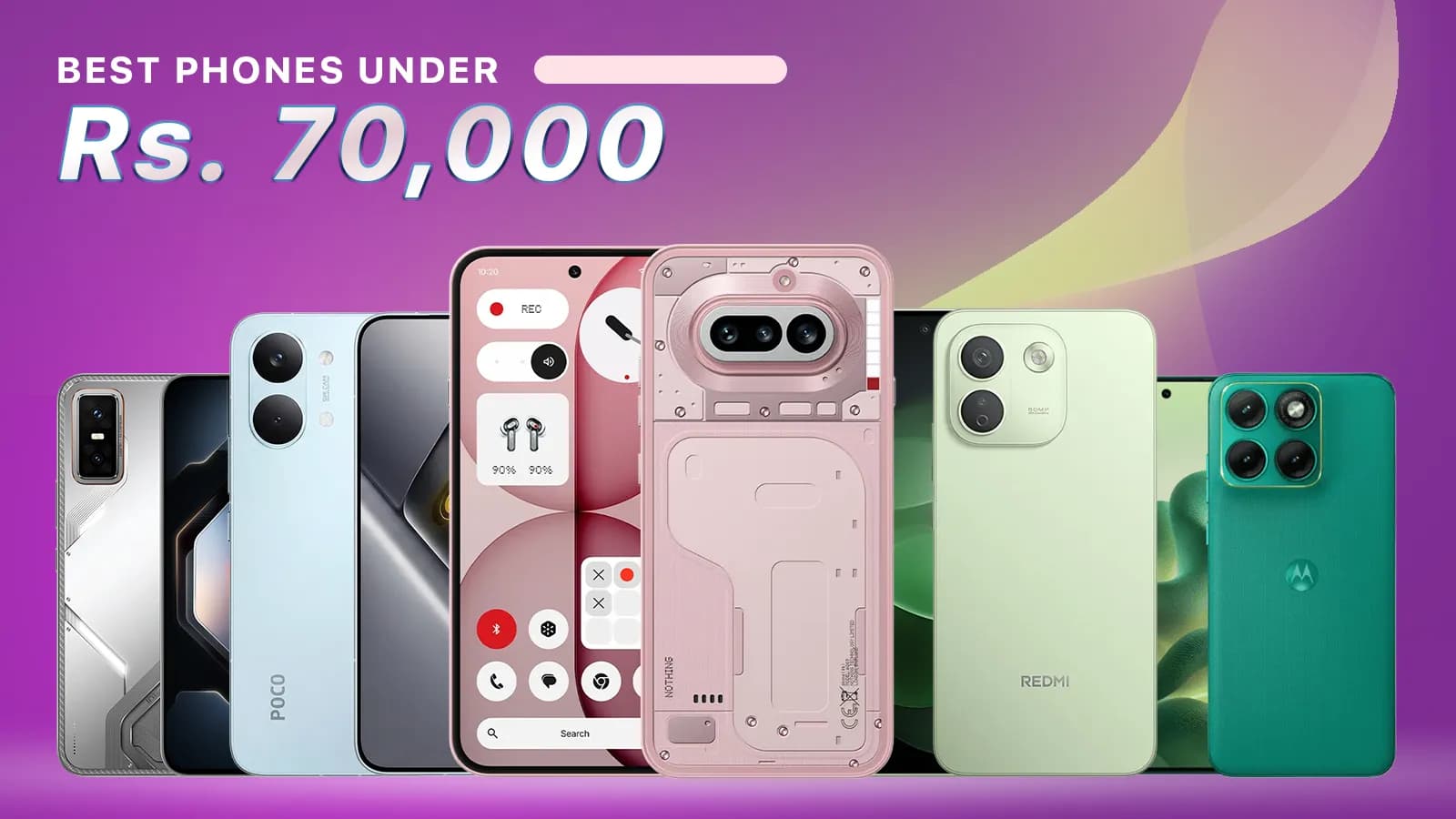
Quick Comparison: Top Phones Under 70K
| Phone | Display | Processor | Cameras | Battery | Best For |
| Nothing Phone 4a (8/128GB) — Rs. 69,999 | 6.78”, 1.5K, 120Hz AMOLED | Snapdragon 7s Gen 4 (4nm) | 50MP main + 50MP telephoto + 8MP ultrawide + 32MP selfie | 5,080 mAh, 50W charging | Best overall and camera flexibility |
| Motorola Edge 70 Fusion (12/256GB) — Rs. 66,999 | 6.78”, 1.5K, 144Hz AMOLED | Snapdragon 7s Gen 4 (4nm) | 50MP main + 13MP ultrawide + 32MP selfie | 7,000 mAh, 68W charging | Best for clean software and display |
| POCO X8 Pro (8/256GB) — Rs. 69,999 | 6.59”, 1.5K, 120Hz AMOLED | Dimensity 8500-Ultra (4nm) | 50MP main + 8MP ultrawide + 20MP selfie | 6,500 mAh, 100W charging | Best for display and compact design |
| Infinix GT 30 Pro (8/256GB) — Rs. 65,999 | 6.78”, 1.5K, 144Hz AMOLED | Dimensity 8350 Ultimate (4nm) | 108MP main + 8MP ultrawide + 13MP selfie | 5,500 mAh, 45W charging | Best for gaming |
| Redmi Note 17 Pro Max (8/256GB) — Rs. 69,999 | 6.83”, 1.5K, 120Hz AMOLED | Snapdragon 6 Gen 5 (4nm) | 50MP main + 8MP ultrawide + 32MP selfie | 10,000 mAh, 100W charging | Best for battery life and durability |
How We Picked the Best Phones Under Rs. 60,000
When I evaluate smartphones for our readers, I refuse to rely on raw marketing hype or spec sheets alone. Buying a phone in Nepal requires a practical look at how these devices perform in real life as well. Like taking into account local availability, official warranty support, and long-term reliability. I examine each model through a rigorous, consistent framework to ensure you get genuine value for your money.
I also kept one hard rule: no phone gets a free pass. If the camera is excellent but the update policy is vague, I say so. If the chipset benchmarks look great but the phone throttles after twenty minutes of gaming, that goes in too. All in all, the criteria I use for every phone are:
- Price and value — The first is the price of the phone and the value it offers. I checked the actual selling price of each phone in Nepal, making sure to consider the specific RAM and storage variant rather than just the starting price. I also looked at what you would have to compromise on at that price and whether the overall package still makes sense compared to its competitors.
- Performance — Then I focused on how each phone performs in everyday use, from basic navigation and multitasking to running demanding games. Besides looking at the chipset, I paid attention to heat management, frame-rate stability, and whether the phone can maintain consistent performance during longer gaming sessions.
- Software — I also explored the overall software experience, including the interface, unwanted preinstalled apps, advertisements, and useful customization features. Furthermore, I checked how frequently each manufacturer provides updates and what its official Android OS upgrade and security patch commitments look like.
- Display — From display panel technology to screen size, resolution, refresh rate, and brightness, I looked at all the display specifications. But I didn’t stop there. I also considered how the screen feels during everyday use, particularly its smoothness, colour reproduction, and readability when using the phone outdoors in bright sunlight.
- Camera — I evaluated the cameras of all phones across different scenarios, from regular daylight photography to low-light shots, portraits, selfies, and videos. I paid attention to image processing, colour consistency, and stabilization to see how reliable the cameras are, while checking whether the additional lenses offer any practical benefit.
- Battery and charging — Battery capacity and charging speed were also important parts of my evaluation, but I didn't rely on specifications alone to judge a phone's battery performance. I paid just as much attention to real-world endurance, looking at how well each device handled everyday tasks, how quickly the battery drained throughout the day, and whether it could comfortably last until bedtime on a single charge.
- Warranty and after-sales support — Beyond the phone's specifications and features, I wanted to understand what kind of support buyers can expect after purchasing it in Nepal. This included checking who honours the official warranty, how accessible the service centres are, and whether the brand has clearly defined replacement, repair, and return policies.
Best Phones Under Rs. 70,000
Nothing Phone 4a — Best overall and camera flexibility
Price: Rs. 69,999
Variant: 8GB RAM, 128GB storage
| Specification | Details |
| Display | 6.78” FHD+ AMOLED panel, 120Hz refresh rate, 4,500 nits brightness |
| Processor | Qualcomm Snapdragon 7s Gen 4 (4nm) |
| RAM / Storage | 8/12GB RAM, 128/256GB storage |
| Rear Camera | 50MP f/1.88 main + 8MP f/2.2 ultrawide + 50MP f/2.88 periscope telephoto (3.5x optical zoom) |
| Front Cameras | 32MP f/2.2 sensor |
| Battery and Charging | 5,080 mAh with 50W charging |
| Network | 4G LTE, 5G |
| Software | Nothing OS 4.1 on top of Android 16 |
If I had to sum up the Nothing Phone 4a in one line, it's the phone for people who want something that feels different and runs smoothly without a spec-sheet argument. Its transparent-style design and rear “Glyph” lighting give it a distinct look, but the more important feature is the camera setup, which includes a proper 3.5x periscope telephoto camera. Something that is increasingly unusual at this price.

That telephoto lens gives you a more useful way to photograph people, distant subjects, and tighter compositions without relying entirely on digital zoom. Main-camera photos have good detail and dynamic range with a slightly contrasty look, while the ultrawide is the weaker part of the setup, so I would not assume every lens will deliver the same quality. Similarly, Nothing OS is another reason to consider the Phone 4a. Its interface is relatively clean, offers useful customisation, and avoids the clutter that can make a phone feel tiring to use.
Performance-wise, the Snapdragon 7s Gen 4 chip powering this phone is a capable midrange processor for everyday tasks, multitasking, and casual-to-moderate gaming. I would not buy it as a dedicated gaming phone, though; there are some better-suited gaming phones in this segment. You also get a decent 5,080 mAh battery on the Nothing Phone 4a—I got through a full day of mixed use without hunting for a charger. The 45W charging isn't the fastest here, but it tops up quickly enough over lunch.
Pros:
- Versatile rear camera system with a 3.5x telephoto camera
- Clean, ad-free software, 3 + 6 years of updates
- A distinctive design: sharp, bright AMOLED display
- Efficient chipset that stays cool under normal use
Cons:
- 128GB of base storage may feel tight for some users
- Not the most powerful chipset for gaming
- Limited service-centre footprint in Nepal compared to Samsung or Xiaomi
- A noticeably weak 8MP ultrawide camera in the arsenal
Check price: Nothing Phone 4a
Motorola Edge 70 Fusion — Best for clean software and display
Price: Rs. 66,999
Variant: 12GB RAM, 256GB storage
| Specification | Details |
| Display | 6.8” 1.5K AMOLED panel, 144Hz refresh rate, 5,200 nits brightness |
| Processor | Qualcomm Snapdragon 7s Gen 4 (4nm) |
| RAM / Storage | 8/12GB RAM, 128/256GB storage |
| Rear Camera | 50MP f/1.8 main + 13MP f/2.2 ultrawide + 3-in-1 light sensor |
| Front Camera | 32MP f/2.2 sensor |
| Battery and Charging | 7,000 mAh with 68W charging |
| Network | 4G LTE, 5G |
| Software | Android 16 |
I would look at the Motorola Edge 70 Fusion if I wanted a premium-looking phone with a large curved display, a clean Android-style interface, and a big battery. I found its curved 6.8-inch AMOLED display paired with a blazing-fast 144Hz refresh rate to be an absolute treat for scrolling through feeds and streaming Netflix series. The curved edges also provide an ergonomic feel in the hand, making it comfortable to hold for hours at a time.

It runs on Snapdragon 7s Gen 4, the same chip as the Nothing Phone 4a, so everyday speed is smooth, and the 12GB of memory gives multitasking some extra breathing room. The Edge 70 Fusion is also impressively slim and light, even with a massive 7,000 mAh battery. Meanwhile, the phone also has IP68 and IP69 ratings, MIL-STD-810H toughness, and Gorilla Glass 7i on the front.
On the camera side, you get a 50MP Sony main sensor with OIS, a 13MP ultrawide that also handles macro, and a 32MP selfie camera with a wide field of view that suits group shots. There's no telephoto lens here, but I can tell you that daylight results from the Edge 70 Fusion are consistent, and low light is handled well with good flare control too. It runs near-stock Android 16, and Motorola has also promised 3 major OS updates for this phone. So overall, I would choose it for a simple daily experience and battery flexibility, not for the strongest camera or gaming performance.
Pros:
- 7,000mAh battery in a slim, light body
- Large 144Hz AMOLED display with premium curved edges
- Near-stock Android 16 with very little bloatware apps
- IP68/IP69 rating plus MIL-STD-810H toughness
Cons:
- Warms up quickly in long gaming sessions
- No dedicated telephoto camera
- The curved display may not be practical for everyone
Check price: Motorola Edge 70 Fusion
POCO X8 Pro — Best for display and compact design
Price: Rs. 69,999
Variant: 8GB RAM, 256GB storage
| Specification | Details |
| Display | 6.59” 1.5K AMOLED panel, 120Hz refresh rate, 3,500 nits brightness |
| Processor | MediaTek Dimensity 8500-Ultra (4nm) |
| RAM / Storage | 8/12GB RAM, 256/512GB storage |
| Rear Camera | 50MP f/1.5 main + 8MP f/2.2 ultrawide |
| Front Camera | 20MP f/2.2 sensor |
| Battery and Charging | 6,500 mAh with 100W charging |
| Network | 4G LTE, 5G |
| Software | HyperOS 3 on top of Android 16 |
For buyers who want raw performance and a fairly compact design without overspending, the POCO X8 Pro is a mighty contender. Powered by the flagship-tier Dimensity 8500-Ultra processor, I am impressed by how effortlessly it handles heavy gaming titles and intensive multitasking. Even the thermal management is well-handled for a relatively compact phone, preventing severe throttling during extended gaming sessions. If you care about sustained performance for gaming or video editing on the go, this is a great pick.

POCO has kept the screen a little more compact than some rivals at 6.59”, which makes the phone easier to manage without sacrificing much viewing space. The display supports a 120Hz refresh rate, 1.5K resolution, 3,500 nits of peak brightness, and 3,840Hz PWM dimming, which makes it easier on the eyes in dim rooms. In everyday use, that combination means text looks crisp, colors feel rich, and supported games look perfectly smooth. But then again, its camera setup is more practical than ambitious, including a 50MP Sony main camera with OIS, an 8MP ultrawide, and a 20MP selfie camera.
The battery side is much better: a 6,500mAh cell with 100W charging, and the adapter is included in the box itself that can complete fill up the phone in around 50 minutes. In terms of software, the POCO X8 Pro’s HyperOS 3 is feature-rich rather than minimal, so expect to spend a few minutes in settings trimming what you don't need. I also love that POCO has committed to a generous 4 years of OS and 6 years of security updates this time.
Pros:
- Compact body with IP68/IP69K rating
- Strong performance with Dimensity 8500-Ultra
- Excellent display, 12-bit colors, high-frequency PWM dimming
- 6,500mAh battery with 100W charging
- 4 Android upgrades and 6 years of security updates
Cons:
- Not the most versatile camera setup
- Camera is the weakest part, especially in low light
- Hyper OS software comes with pre-loaded software and ads
Check price: POCO X8 Pro
Infinix GT 30 Pro — Best for gaming
Price: Rs. 65,999
Variant: 8GB RAM, 256GB storage
| Specification | Details |
| Display | 6.78” 1.5K AMOLED panel, 144Hz refresh rate, 4,500 nits brightness |
| Processor | MediaTek Dimensity 8350 Ultimate (4nm) |
| RAM / Storage | 8/12GB RAM, 256/512GB storage |
| Rear Camera | 108MP f/1.89 main + 8MP f/2.2 ultrawide |
| Front Camera | 13MP f/2.4 sensor |
| Battery and Charging | 5,500 mAh with 45W charging |
| Network | 4G LTE, 5G |
| Software | XOS 15 on top of Android 15 |
The Infinix GT 30 Pro is the only phone in this list that was designed for gaming first and everything else second. It uses a MediaTek Dimensity 8350 Ultimate with LPDDR5X RAM and UFS 4.0 storage, and it has been helped by “Cyber Mecha” styling, rear RGB lighting, and pressure-sensitive gaming triggers that make it stand out immediately. Those shoulder-style controls can be mapped to in-game actions, which can be useful in supported shooter and action games.

I played a few graphics-intensive games for extended stretches, and while the phone did get a little warm, it didn't throttle noticeably or drop frames the way some competitors do. The POCO X8 Pro has a faster chipset on paper, so this is how I would separate the two: POCO is the better pick for raw processing power, while the GT 30 Pro offers a more specialised gaming package. Especially since you also get its gaming kit with a cooling fan for free. Likewise, its 144Hz AMOLED display with a 1.5K resolution makes games look sharp and feel responsive.
But the cameras are only average here. The 108MP main sensor manages good detail and better dynamic range than you might expect, but white balance can be off in bright scenes. On the other hand, its 13MP ultrawide lens is only average, as you’d expect. As for software, Infinix’s XOS 15 has improved a lot over the years, but it still carries more pre-installed apps than I’d prefer. Its 5,500 mAh battery perfectly handles a day of mixed use, and the 45W charging is adequate if not class-leading. That said, the Infinix GT 30 Pro is the only phone on our list with wireless charging support as well.
Pros:
- Stable 120fps gaming in supported titles
- Shoulder triggers, 144Hz AMOLED, and a free cooling fan
- 144Hz 1.5K AMOLED display is smooth and sharp for games
- Distinctive design if you enjoy the gaming aesthetic
Cons:
- Average cameras and a weak ultrawide lens
- Design may feel too “gamer” for professional settings
- Shortest update policy; 2 Android upgrade + 3 years of security updates
Check price: Infinix GT 30 Pro
Redmi Note 17 Pro Max — Best for battery life and durability
Price: Rs. 69,999
Variant: 8GB RAM, 256GB storage
| Specification | Details |
| Display | 6.83” 1.5K AMOLED panel, 120Hz refresh rate, 3,500 nits brightness |
| Processor | Qualcomm Snapdragon 6 Gen 5 (4nm) |
| RAM / Storage | 8/12GB RAM, 128/256GB storage |
| Rear Camera | 50MP f/1.5 main + 8MP f/2.2 ultrawide |
| Front Camera | 32MP f/2.2 sensor |
| Battery and Charging | 10,000 mAh with 100W charging |
| Network | 4G LTE, 5G |
| Software | HyperOS 3 on top of Android 16 |
Redmi Note 17 Pro Max has one headline feature, and it's a big one: a 10,000mAh silicon-carbon battery, which is far larger than what the other phones here offer. So forget about an all-day battery; the Note 17 Pro Max can comfortably last 2 – 3 days even under the most demanding workload. Xiaomi has also combined that with speedy 100W wired charging that can completely refill the phone in a little over an hour.

The Note 17 Pro Max also carries IP66, IP68, IP69, and IP69K ratings and a 3-meter drop resistance. Making it one of the more durability-focused options in this price range. But keep in mind that it has plastic frames and a plastic back—and at nearly 230 grams—it’s quite heavy too. Up front, the Note 17 Pro Max has a 6.83” AMOLED display, which is excellent for the price. It has a smooth 120Hz refresh rate, Gorilla Glass Victus 2 protection, 3,500 nits of peak brightness, and DC dimming + 3,840Hz PWM dimming for comfortable viewing.
With the Snapdragon 6 Gen 5 chipset inside, it handles regular apps, communication, browsing, and moderate multitasking fine. But it’s definitely not the performance leader in any way. Its 50MP main camera includes OIS and is paired with an 8MP ultrawide lens and a 32MP front camera. I found its main camera to be useful for everyday photos, but the overall camera system is less versatile than Nothing’s telephoto-equipped setup. That’s why I would choose the Redmi Note 17 Pro Max for its large battery, tough build quality, and a large screen, while accepting its heavy design, a modest chipset, and average cameras.
Pros:
- 10,000mAh battery that lasts 2 to 3 days or more
- IP66 / IP68 / IP69 / IP69K ratings plus Gorilla Glass Victus 2
- A large, high-quality AMOLED display
- 4 Android upgrades and 6 years of security updates
Cons:
- 229.5 gm weight; has a plastic back and frame
- Weakest chip in the group, with some sluggishness
- Not the most versatile camera setup
Check price: Redmi Note 17 Pro Max
Best Phones Under 70K by Use Case
| Your priority | Best phone | Why it stands out |
| Best overall | Nothing Phone 4a | For its most rounded mix of camera flexibility, clean software, and a good display. |
| Best camera | Nothing Phone 4a | A well-optimized main camera and a 3.5x periscope telephoto lens give you a versatile camera experience. |
| Best for gaming | Infinix GT 30 Pro | The 144Hz screen, pressure-sensitive triggers, and Gaming Kit make it the most gaming-focused option. |
| Best for battery life | Redmi Note 17 Pro Max | Its 10,000mAh battery routinely lasts two days with heavy use, and a 100W charger is in the box. |
| Best display | POCO X8 Pro | A 12-bit AMOLED with Dolby Vision, a 3,500-nit peak, and 3840Hz PWM dimming is the most complete screen spec in a compact body. |
| Best software | Motorola Edge 70 Fusion | Its close-to-stock Android approach feels clean and straightforward to use. |
| Best for durability | Redmi Note 17 Pro Max | For its multi-level IP protection, 3-meter drop resistance, and Gorilla Glass Victus 2 protecting the display. |
| Best for long-term use | Nothing Phone 4a | The clean interface, camera versatility, and six-year security commitment suit a balanced daily phone |
Official vs Grey-Market Phones in Nepal
When I say "official" in Nepal, I mean a phone imported and sold through the brand's authorised distributor, with a warranty the brand's own service network will honour. On the other hand, "grey-market" phones could be genuine devices that arrive by other routes, such as personal imports, the open border, or bulk orders by individual shops. That doesn't make them fake or faulty, but it changes what happens when something goes wrong. I also keep one point in mind: "official" always applies to a specific model, variant, and seller, so an official listing for one version tells you nothing about another.
The way I see it, the risk with a grey unit is usually the paperwork rather than the phone. Some brands won't service units they didn't distribute, the warranty may only be the shop's own promise, accessories can differ, and regional versions can have different hardware. You can see that in this very guide: the Infinix GT 30 Pro is listed at 5,500 mAh in some places and 5,200 mAh in others. That said, I wouldn't assume every official listing is identical either. Warranty length, what counts as physical damage, and who handles repairs can vary from seller to seller.
The savings on a grey unit can be real, but I count it against what you lose: service access, replacement terms, and sometimes the charger. Even an IP68 rating doesn't help much, because most warranties exclude liquid damage, so read the exclusions. Before I pay for any phone, I want an invoice that shows the model, variant, IMEI details, a stamped warranty card, and the warranty terms in writing.
Phone Prices, Stock, and Offers in Nepal
In the past few months, phone prices in Nepal have moved more than most people expect. So I always recommend checking the latest pricing, as smartphone prices in Nepal can change depending on exchange rates, newly released models, seasonal offers, and ongoing promotions. At GBN Store, we also run various promotions and discounts at our store throughout the year, so I'd suggest confirming the current price of your preferred model and storage variant before placing an order.
| Phone | Variant | Price | Stock | Active Offer |
| Nothing Phone 4a | 8/128GB | Rs. 69,999 | In stock | 0% EMI (9 months) |
| Motorola Edge 70 Fusion | 12/256GB | Rs. 66,999 | In stock | N/A |
| POCO X8 Pro | 8/256GB | Rs. 69,999 | In stock | 0% EMI (9 months) |
| Infinix GT 30 Pro | 8/256GB | Rs. 65,999 | In stock | 0% EMI (9 months) |
| Redmi Note 17 Pro Max | 8/256GB | Rs. 69,999 | In stock | 0% EMI (9 months) |
Is it Worth Increasing Your Budget to Rs. 75,000?
My short answer is that I don't think an extra Rs. 5,000 automatically buys a better phone. The two obvious options just over the line are the Samsung Galaxy A37 5G (8/128GB) at Rs. 74,999 and the OnePlus Nord CE6 (8/256GB) at Rs. 74,999.
And here, the Galaxy A37’s main selling point is its software. Samsung promises 6 major Android upgrades for this phone, far more than any other phone on our list. It also has an IP68 rating and a nice 6.7” Super AMOLED screen. But it uses a not-so-powerful Exynos 1480 chip, a modest 5,000 mAh battery, no telephoto camera, and only comes with 128GB storage for the price. I'd call it slower than every phone in this segment, so the extra money buys a name and an update promise, not performance.
The Nord CE6 is the more interesting of the two. It has the same Snapdragon 7s Gen 4 as the Nothing and Motorola, but with a bigger 7,500 mAh battery, 80W charging, a 1.5K 144Hz AMOLED display, and a very tough IP66 / IP68 / IP69 / IP69K rating. The compromises are in the camera department, since OnePlus has gone with a useless 2MP auxiliary camera in place of an ultrawide lens. Plus, its 2 years of OS and 4 years of security update promise is also shorter than what Nothing and Motorola bring to the table.
How to Choose a Phone Under Rs. 70,000
1. Start with the processor
The processor affects how quickly apps open, how comfortably you can multitask, and how well a phone handles games over a long session. I would compare the exact chip models, not just the Snapdragon or Dimensity name: the POCO X8 Pro’s Dimensity 8500-Ultra is the strongest raw performer in this group, followed by the Infinix GT 30 Pro’s Dimensity 8350 Ultimate, while the Snapdragon 7s Gen 4 phones are better treated as balanced everyday devices. The Redmi Note 17 Pro Max is more about battery and durability than top-tier gaming.
2. Prioritize RAM and storage
You check physical RAM, not "extended RAM" that borrows storage space, because they aren’t the same thing. And it’s always a good idea to have more physical RAM on your phone since that gives you more comfortable headroom to multitask. Whereas storage is harder to expand on these phones since none of them support microSD cards, so think about how many games, photos, and 4K videos you keep locally.
3. Look at the display beyond the refresh rate
Every phone here is AMOLED at 120Hz or higher, so the refresh rate won't set them apart. I'd look at brightness under sunlight conditions, HDR support for video, and PWM dimming for eye comfort. Size matters too: the 6.59” POCO X8 Pro is the most compact on our list, while the 6.83” Redmi is great for video but heavy. Keep in mind that the 144Hz display on the Motorola Edge 70 Fusion can feel smoother, but it will also use more power.
4. Never judge the camera by megapixels alone
A 108MP camera is not automatically better than a 50MP camera. Sensor size, lens quality, optical stabilisation, image processing, autofocus, and low-light handling have a much bigger effect on the photos you keep. Most of the ultrawide cameras here are 8MP and average. Also, you should check portrait edge detection, selfie quality, and video stabilisation if you record people or moving subjects regularly.
5. Consider battery size and charging together
Battery capacity tells you how long a phone lasts, and charging speed tells you how annoying it is when it doesn't, so I would consider both. Then again, battery capacity alone could be misleading. Because the Nothing Phone 4a’s 5,080 mAh battery and the Infinix GT 30 Pro’s 5,500 mAh battery both land at around seven hours of screen-on time. Things like screen brightness, signal strength, gaming, and your overall usage pattern all change the result, so I'd never assume battery life from the mAh figure alone.
6. Think about software and long-term support
Software support matters because security patches and Android upgrades can keep a phone safer and more useful for longer. You should look at how clean and responsive the software feels, whether it comes with unnecessary apps or bloatware, and how well the manufacturer handles software updates. This includes the promised Android upgrades, security update support, and the manufacturer's track record of delivering updates on time.
7. Check the warranty service and official Nepal availability
A phone can look like a bargain until a repair becomes difficult. Before buying, I would confirm who provides the Nepal warranty, which service centre accepts the exact model number, what proof of purchase is needed, and which parts are covered. Ask about screen, liquid, and accidental-damage exclusions, and get the return or replacement terms in writing. It’s always a better idea to buy an official phone instead of a grey-market device as well.
8. Match the phone to how you actually use it
Before looking at the spec sheet, you should choose one or two priorities. A balanced phone will suit most people, but a specialist model can be a better buy when you know exactly what you want.
| If you care most about… | Prioritize |
| Camera | Sensor and lens quality, OIS/EIS, processing, camera features |
| Gaming | Processor, sustained performance, cooling system, display |
| Movies & YouTube | Display quality, speakers, battery |
| Social media | Camera, display, performance, storage |
| Student use | Durability, battery, performance, software |
| Long battery life | Battery capacity, chipset, charging speed, software |
| Long-term usage | Performance, software support, storage, warranty, service |
| Best overall value | Balanced overall performance rather than any one specification |
9. Don't chase specifications
More than anything else, don’t fall for the big numbers on a product page. It can look convincing at first, but it does not automatically guarantee a better phone. Megapixels do not tell you whether colors and skin tones look natural; a 144Hz refresh rate does not matter in an app that runs at 60Hz; 12GB RAM will not fix a weak processor; and a 10,000 mAh battery does not make a heavy phone comfortable to carry.
I would look at how the camera is processed, how efficiently the chipset runs, how well the phone stays cool, and whether the software is updated regularly. Comparable real-world results and ownership value matter more than one headline specification.
Buying Checklist: What to Check Before Buying a Phone Under Rs. 70,000
Before making your final decision, there are a few important things I recommend checking:
- Confirm the exact RAM and storage variant
- Check the current Nepal price
- Compare the final delivered price, including shipping and offers
- Confirm official Nepal warranty
- Check the charger and included accessories
- Check return and replacement terms
- Confirm desired 4G/5G support and local carrier compatibility
- Check the software update policy
Frequently Asked Questions (FAQs)
1. Which is the best phone under Rs. 70,000 in Nepal?
The Nothing Phone 4a is the best phone under Rs. 70,000 in Nepal if you want the best balance of camera flexibility and software. Choose the POCO X8 Pro instead if raw performance and gaming matter more.
2. Which phone under Rs. 70,000 has the best camera?
With its 50MP main, an 8MP ultrawide, and a dedicated 3.5x periscope telephoto lens, the Nothing Phone 4a is the camera phone to beat in this segment.
3. Which is the best gaming phone under Rs. 70,000?
For gaming controls and accessories, I would pick the Infinix GT 30 Pro. For stronger raw chipset performance, the POCO X8 Pro is the alternative I would compare before buying.
4. Which phone under Rs. 70,000 has the best battery life?
The Redmi Note 17 Pro Max is the clear leader with its 10,000 mAh battery, which can last two to three days with heavy use. The trade-off is the weight, since it's the heaviest phone under Rs. 70,000 in Nepal.
5. Which phone under Rs. 70,000 is the best value for money?
Thanks to its versatile set of cameras, reliable performance, clean software, nice display, and an all-day battery life, the Nothing Phone 4a is the best value-for-money phone here.
6. Is 8GB RAM enough for a phone under Rs. 70,000?
For normal apps, multitasking, photos, and most games, 8GB of physical RAM is a reasonable baseline. Choose 12GB if you regularly keep many demanding apps open, but do not confuse virtual RAM with physical memory.
7. Should I buy 128GB or 256GB storage?
I would choose 256GB if you download large games, record lots of video, or keep years of photos on the phone. Otherwise, 128GB should be fine for most casual users.
8. Is it worth increasing the budget to Rs. 75,000?
I would stretch only for a specific benefit: the Galaxy A37 5G for long software support and IP68 protection, or the OnePlus Nord CE6 for its high-refresh display and large battery.
9. Is it worth buying a grey-market phone in Nepal?
While a grey-market phone can be cheaper, you are putting things like warranty and after-sales service at risk. So we will always advise buying official phones.
10. How do I check a phone’s official warranty in Nepal?
You should ask the seller to identify the warranty provider in writing, show the warranty card or digital registration process, and confirm the exact IMEI with the authorised distributor or service centre. Keep the VAT invoice and seller contact details.
Final Verdict
In the current Nepali smartphone market, you do not need to spend more than Rs. 70,000 to get a phone with a premium display, capable performance, and a useful camera. For a balanced phone with the most flexible camera setup, the Nothing Phone 4a is my overall pick, particularly if you value a clean software experience.
The alternatives are easy to separate. I would choose the POCO X8 Pro for the strongest raw performance, a compact design, and a sharp, bright display; the Infinix GT 30 Pro for its gaming triggers and bundled gaming accessories; the Redmi Note 17 Pro Max for exceptional battery capacity and a durability-focused build; and the Motorola Edge 70 Fusion for a clean Android-style experience, a curved 144Hz screen, and a large battery. But you should also know that each of them has a clear trade-off, whether that is camera versatility, weight, gaming power, or regional battery differences.
Before ordering from any store, confirm the current Nepal price, exact RAM/storage variant, stock, product-page details, charger and accessories, network compatibility, and the warranty that applies to that seller. That final check is what turns a good-looking specification sheet into a phone purchase I would feel comfortable recommending.