

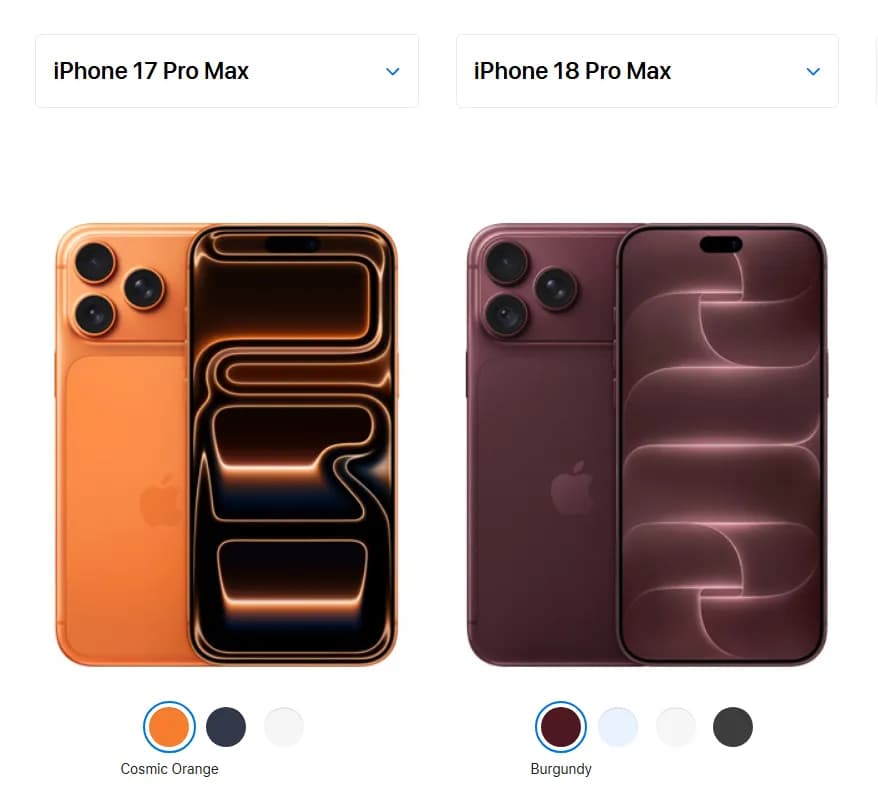
Quick Verdict: iPhone 18 Pro Max or iPhone 17 Pro Max?
If you want the newest features and the best battery life, low-light camera, and sustained speed Apple has ever put in an iPhone, the iPhone 18 Pro Max is the one to buy. But if you care about better value for money instead, the iPhone 17 Pro Max is the smarter purchase. Mostly because the screen, the design, and three of the four cameras are essentially the same.
And in Nepal, the price gap of Rs. 37,401 on the 256GB model gets you refinements that most people will only notice at the edges of their day. My direct recommendation is to buy the 18 Pro Max only if you’re coming from an iPhone 15 Pro Max or older—or if you shoot a lot at night, game for long stretches, or live on your battery. For everyone else, the 17 Pro Max gives you most of the experience for noticeably less money, and if you already own one, I’d keep it.
iPhone 18 Pro Max vs iPhone 17 Pro Max Price in Nepal
Variant | iPhone 18 Pro Max | iPhone 17 Pro Max | Price Difference |
256GB | Rs. 279,900 | Rs. 242,499 | - Rs. 37,401 |
512GB | Rs. 322,900 | Rs. 284,599 | - Rs. 38,301 |
1TB | Rs. 407,900 | Rs. 327,099 | - Rs. 80,801 |
2TB | Rs. 534,900 | Rs. 411,399 | - Rs. 123,501 |
iPhone 18 Pro Max vs iPhone 17 Pro Max: Specifications Compared
Feature | iPhone 18 Pro Max | iPhone 17 Pro Max |
Design | 163.4 x 78 x 8.75 mm, 249 gm; aluminum unibody | 163.4 x 78 x 8.75 mm, 231 gm; aluminum unibody |
Color Options | Burgundy, Glacier, Silver, Black | Cosmic Orange, Deep Blue, Silver |
Display | 6.9-inch LTPO OLED, 2868 × 1320, 120Hz, 3000 nits peak outdoor; smaller Dynamic Island, up to three Live Activities | 6.9-inch LTPO OLED, 2868 × 1320, 120Hz, 3000 nits peak outdoor; standard Dynamic Island |
Chipset | A20 Pro (2nm), 6-core CPU, 7-core GPU, dual 16-core Neural Engine | A19 Pro (3nm), 6-core CPU, 6-core GPU, 16-core Neural Engine |
RAM | 12GB | |
Storage | 256GB, 512GB, 1TB, 2TB | |
Cooling | Next-gen vapor chamber with three times the surface area; chip and memory side by side | Vapor chamber (first on an iPhone) |
Cameras | 48MP Main with variable aperture (f/1.48 – f/4.0), 48MP Ultra Wide, 48MP 4x Telephoto; 18MP Center Stage selfie | 48MP Main (f/1.78), 48MP Ultra Wide, 48MP 4x Telephoto; 18MP Center Stage selfie |
Video | 4K Dolby Vision up to 120 fps; Cinematic up to 4K 60 fps; Pro controls; ProRes RAW, Apple Log 2, Genlock; up to 24x digital zoom | 4K Dolby Vision up to 120 fps; Cinematic up to 4K 30 fps; ProRes RAW, Apple Log 2, Genlock; up to 15x digital zoom |
Battery | 5,567mAh (eSIM-only) or 5,391mAh (SIM tray); up to 45 hrs video playback (eSIM-only model) | 5,088mAh (eSIM-only) or 4,832mAh (SIM tray); up to 39 hrs video playback (eSIM-only model) |
Charging | Up to 50% in about 15 min (60W-capable AVS adapter, sold separately); 25W MagSafe/Qi2 | Up to 50% in 20 min (40W adapter, sold separately); 25W MagSafe/Qi2 |
Software | iOS 27 out of the box, with Siri AI (beta) | Launched on iOS 26; iOS 27 available as an update |
Connectivity | Apple C2 modem, 5G with mmWave band support, Wi-Fi 7, Bluetooth 6, USB-C (USB 3, 10Gb/s); nano-SIM plus eSIM on the international model | 5G sub-6, Wi-Fi 7, Bluetooth 6, USB-C (USB 3, 10Gb/s); nano-SIM plus eSIM on the international model |
Durability | IP68; Ceramic Shield 2 front, Ceramic Shield back | |
Key Differences: iPhone 18 Pro Max vs iPhone 17 Pro Max
Design, Weight and Colors
Just looking at these two phones, I am sure anyone would struggle to tell them apart. The iPhone 18 Pro Max and the iPhone 17 Pro Max have the exact same footprint, along with the aluminum unibody and a wide camera plateau. That means cases made for the 17 Pro Max should generally fit on the new one as well, although I’d still check before you buy a new one. But Apple has noticeably improved the color match between the rear glass and the frame this time, which gives the back a slightly cleaner, more seamless look.
However, the thing you’ll notice immediately is the weight—since the iPhone 18 Pro Max weighs 249 gm against 231 gm for the 17 Pro Max. Now, 18 grams doesn’t sound like much, but once you add a case and a screen protector, the newer phone starts to feel like a brick during one-handed use and long reading sessions. It’s not like Apple made it heavier for no reason, since the 18 Pro Max gets a bigger battery and a larger vapor chamber, but still.
Colors are the easiest way to tell them apart. The 18 Pro Max comes in “Black”, “Silver”, “Glacier” and a new “Burgundy”, while the 17 Pro Max is available in “Silver”, “Cosmic Orange” and “Deep Blue”. Other than this, they both share the same aluminum unibody design, an IP68 dust and water resistance, and Ceramic Shield protecting the front glass.
Display and Dynamic Island
On paper, both of them have the same 6.9-inch OLED panel with a 120Hz refresh rate and up to 3,000 nits of outdoor brightness. Side by side, its really difficult to pick a better screen. The 18 Pro Max looks a tad cooler in terms of color temperature, but it’s not something your eyes will catch in most cases. Anti-reflective performance is also about the same, so strong direct light still produces visible reflections on both.
The real change is at the top of the screen. The Dynamic Island is roughly a third narrower on the iPhone 18 Pro Max because Apple moved the infrared part of Face ID under the display, and it can now show up to three Live Activities at once. In daily use, that means navigation, music, and a timer can sit there together. I found the cleaner top edge pleasant and the multi-activity feature handy rather than essential, and Face ID unlocked just as quickly and reliably as on the 17 Pro Max. The small patch of reduced pixel density above the sensor is invisible in normal use.
Likewise, speakers get a light retune, with voices sounding a little richer and clearer on the newer phone. It’s a nice touch for podcasts and video calls, but nothing I’d upgrade for.
Performance, Gaming and Thermals
Now moving to the performance, the new iPhone 18 Pro Max is powered by A20 Pro. It is Apple’s first 2nm chip, with faster CPU and GPU cores, 50% more memory bandwidth, and double the total Neural Engine cores. And looking at third-party benchmark scores, you can expect up to 26% higher single-core, close to 30% higher multi-core, and about 40% higher GPU scores. But if I was scrolling, messaging, editing photos, or switching between apps, the 17 Pro Max was already instant; I couldn’t make it feel slow.
Where the A20 Pro shines is sustained performance. Apple moved the memory beside the chip instead of on top of it and attached the whole thing to a vapor chamber with three times the surface area, which it says delivers up to 40% higher sustained performance. In practice, demanding games such as PUBG Mobile and Genshin Impact run at the same frame rates on both phones, around 120 fps and 60 fps respectively.
So, the difference I was talking about is that the 18 Pro Max finishes a long session noticeably cooler, which is what protects performance, battery health, and your palm.
There’s also a forward-looking angle here. Apple is leaning hard on on-device AI, and the newer chip has far more headroom for it with the dual 16-core neural engine. If you plan to keep this phone for four or five years, that headroom matters more than any benchmark does today.
Cameras and Photography
Okay camera is the area where you really could feel a difference. The headline camera change on the iPhone 18 Pro Max is a physical variable aperture lens on its 48MP main camera. It uses six aperture blades and can be adjusted across four different apertures: f/1.48, f/1.8, f/2.8, and f/4.0.
On the other hand, the 17 Pro Max has a fixed f/1.78 lens. As a result, the iPhone 18 Pro Max has much better low-light photography and better control over depth of field. If you close its aperture down to f/4.0 and point it at a streetlight, the blades even create a starburst. In daylight, the two are very close, with the new iPhone 18 Pro Max leaning towards slightly warmer and a bit more contrasty.
The rest of the camera setup hasn’t changed. The ultrawide, the 4x telephoto, and the 18MP selfie camera are the same between the two, so zoom beyond 8x, macro work, and ultrawide shots in very dark scenes still trail the best Android flagships. Some new extras on the 18 Pro Max include Apple Reference Image, which keeps a signed record of what the sensor captured, and new texture and grain controls in Photographic Styles.
Video Recording and Content Creation
Coming to videography, it was already the iPhone’s strongest suit. And both phones sit at the top of the class. Each of them can record 4K Dolby Vision at up to 120 fps, supports ProRes and ProRes RAW, Apple Log 2 and Genlock, and has excellent stabilization.
That being said, the iPhone 18 Pro Max adds the tools creators actually use. Pro controls now let you set aperture, shutter speed, and white balance and watch a histogram, although these need to be set before you hit record, and there’s still no true ISO control. Similarly, Cinematic mode goes up to 4K at 60 fps instead of 4K at 30 fps on the 17 Pro Max, and the subject tracking is impressive. It even picks a person back up after they leave the frame. Cinematic effects can be applied after you shoot, time-lapse can be recorded in 4K Dolby Vision, and Audio Mix can now isolate music as well as voices.
If you shoot reels, vlogs, or client work with an iPhone 17 Pro Max already, your clips will look very similar. The gains are in flexibility, with aperture control for depth of field and Cinematic 4K60 as the two I’d care about most.
Battery Life and Charging
This is the upgrade I appreciated most. The battery is physically larger, at 5,567 mAh on the eSIM-only model or 5,391 mAh on the SIM-tray version on the iPhone 18 Pro Max, against 5,088 mAh and 4,832 mAh for the equivalent 17 Pro Max. Apple rates the eSIM-only 18 Pro Max for up to 45 hours of video playback versus 39 hours for the 17 Pro Max. In standardized active-use testing, it lasts around 19 hours 20 minutes against roughly 18 hours for the older phone, so you gain an hour or more on a heavy day, and I’d call that a meaningful improvement rather than a headline-grabbing one.
Similarly, charging has moved forward too on the 18 Pro Max. With a 60W-capable adapter that supports AVS, it reaches 50% in about 15 minutes, while the same thing takes 5 more minutes on the 17 Pro Max. It’s worth noting that wireless charging stays at 25W on both, and neither of them ships with a charger inside the box. So you’ll need to budget for the right adapter if you want the best speeds.
Another thing you should know is that the Nepali variant comes with a SIM tray, which costs roughly two hours of video playback compared with the eSIM-only version.
Software, AI and Long-Term Use
The iPhone 18 Pro Max ships with iOS 27, which brings a more polished version of the Liquid Glass design we first saw on iOS 26. You can tone down the transparency, icons stand out more clearly, and there are new extra-large widgets. The more interesting change is Siri AI, which is available in beta for now. It’s far more conversational, understands personal context, can act on what’s on your screen, has its own app, and can build Shortcuts from a plain-language prompt as well. It isn’t a ChatGPT replacement for reasoning, but for the first time in years, I actually wanted to use Siri on my iPhone.
Many software improvements have arrived on the 17 Pro Max through the iOS 27 update too. Then again, some features depend on new hardware only found on its successor. Including Apple Reference Image, the new Photographic Styles controls, and the variable aperture. Siri AI also starts in English, with other languages arriving gradually, and Nepali is not on Apple’s list of supported Apple Intelligence languages. If you rely on Nepali voice commands, don’t expect this to change your life yet.
For long-term use, the 18 Pro Max has the obvious edge. The A20 Pro offers double the AI processing power of the A19 Pro, so it’s better placed for the on-device AI features Apple will keep adding. Both phones have 12GB of RAM, and I’d expect both to be supported for years, but the newer chip will stay comfortable for longer.
What Do the Differences Mean in Real-World Use?
So, now that we are clear about the differences but what does it really mean. Let’s take a look at that:
For the Typical Everyday User
If you mostly use WhatsApp, social media, maps, banking apps, and the camera for family photos, I can tell that you will struggle to tell these phones apart. Both are instantly responsive, both have the same lovely display, and both take beautiful pictures in good light. The two things you’ll actually notice are the longer battery life on the 18 Pro Max and the extra weight in your hand. For this kind of user, the price gap is hard to justify.
For Mobile Gamers
While raw frame rates are mostly the same on both phones in even the most demanding games, the iPhone 18 Pro Max pays off in long sessions. It stays cooler and holds its performance for longer. If you regularly play for an hour or more, or play while charging, that difference is real. For casual sessions of 20 to 30 minutes, the 17 Pro Max is already excellent.
For Photographers
In the photography department, the iPhone 18 Pro Max clearly excels in lowlight conditions. Nighttime photography is cleaner, and group shots no longer leave the people at the back soft. Plus, having a choice of aperture lets you decide between creamy separation and edge-to-edge sharpness. If you mostly shoot outdoors in daylight, you’ll see little difference, and if zoom or macro matters more to you, neither phone is the best tool for the job.
For Video Creators
If you shoot professionally with Log or ProRes, both phones do the job superbly. The 18 Pro Max is more flexible, with manual aperture and shutter control, Cinematic 4K60, and cleaner music isolation in Audio Mix. For everyday social clips, the 17 Pro Max is more than good enough. And I’d say the money saved buys a decent microphone or gimbal, which would improve your content more than a new phone would.
For Travelers and Heavy All-Day Users
If you spend long days on navigation, calls, and photos, the 18 Pro Max’s longer battery life and faster charging are the biggest quality-of-life gains. A 15-minute top-up that takes you to about half a charge is genuinely handy at airports and on long road trips.
For People Who Keep Their Phone for Years
Whereas if you tend to hold on to a phone for four or five years, the newer chip, bigger battery and stronger cooling on the 18 Pro Max give you a little more future-proofing. I’d treat that as a modest advantage, not a necessity, because the 17 Pro Max is built to last just as long. A phone you can afford comfortably and look after with a good case will serve you better than a more expensive one you’re nervous about scratching.
Which Phone Should Different Buyers Choose?
Who Should Choose the iPhone 18 Pro Max?
You should choose the iPhone 18 Pro Max if you’re coming from an iPhone 15 Pro Max or older, want the absolute fastest performance, cutting-edge variable aperture technology that Apple offers, and maximum battery life. But only if you’re comfortable with its heft.
Who Should Choose the iPhone 17 Pro Max?
You should choose the older iPhone 17 Pro Max if you want the same screen as its successor, the same design and most of the same cameras at a lower price, and prefer a lighter phone.
Should iPhone 17 Pro Max Owners Upgrade?
No, not unless money is no concern. The longer battery life, better night photos, and the performance upgrades from the A20 Pro chip are nice, yes. But they don’t make up for the price you’d lose after resale, and the display, design, and everyday speed are effectively the same.
Buying the iPhone 18 Pro Max or iPhone 17 Pro Max in Nepal
Authorized vs Grey-Channel Devices
The iPhone 18 Pro Max is officially available in Nepal, and the official 256GB price of Rs. 2,79,900 is a lot of money. It’s definitely tempting to look abroad since the same 256GB model costs around Rs. 52,000 less in Dubai, for example, and the gap widens on higher storage, reaching nearly Rs. 1 Lakh on the 2TB model.
I understand the appeal, but a lower sticker price only tells half the story.
A grey-channel phone can mean no local warranty, uncertain registration, and a potentially different SIM setup, since some countries get eSIM-only models of iPhones. I’d only consider one if the seller can show me the exact model number, a clear IMEI, and written terms. For most people, paying extra for an officially imported unit buys peace of mind, and that’s worth real money on a phone at this price.
Warranty and Service Considerations
Before paying, you should always ask who handles the warranty, what it covers, and where you’d take the phone if something went wrong. An authorized unit gives you a clear service path. A grey unit leaves you relying on the seller’s goodwill, so you’d want any promises in writing.
It’s also worth knowing exactly what the warranty covers. For example, both phones are IP68 rated, but water and dust resistance isn’t permanent and can decrease with wear. And liquid damage isn’t covered under warranty. So, I’d always suggest getting a good case and screen protector, since that will be cheaper than whatever you might end up spending on the repair.
MDMS Registration and IMEI Verification
Before you hand over any money for an imported phone, check its IMEI number. Dial *#06# on the phone and compare the number with the box, the Settings screen, and the invoice. All three of them should be a perfect match.
Next, make sure the phone has been registered in Nepal’s MDMS system, which links the IMEI to the network, because an unregistered handset may not work reliably on local networks. You should also check the serial number against Apple’s warranty-coverage lookup to confirm the phone is genuine and not a replacement or previously activated unit. If a seller hesitates on any of these checks, I suggest walking away.
Regional SIM Compatibility: Physical SIM vs eSIM
This is the most overlooked part of buying an iPhone. Apple builds eSIM-only versions of the iPhone 17 Pro Max and the iPhone 18 Pro Max for markets such as the US, the UAE, Saudi Arabia, Qatar, Japan, and Canada. With no SIM tray at all. Other markets, like Nepal, get a version with a physical SIM tray and a slightly smaller battery.
So, before buying, please check the model number in Settings under General and About, and confirm that your carrier supports eSIM on your plan if the phone is eSIM-only. I’d also suggest comparing the network band list for the model with your carrier’s network. If you’re buying a Dubai or US unit, an eSIM-only phone means you depend on your carrier’s eSIM support, which is a gamble if you haven’t checked first.
Availability, Storage Options and Resale
Both phones come in 256GB, 512GB, 1TB, and 2TB storage options. I’d suggest 256GB for most people, and 512GB if you regularly shoot 4K at 120 fps or ProRes, because those files fill storage fast. The 2TB version costs Rs. 5,34,900 for the 18 Pro Max and Rs. 411,399 for the 17 Pro Max, and I’d only recommend it to people who genuinely need it.
On resale, iPhones hold their value better than most Android phones, and storage tier matters when you sell. Keep the box, the invoice, and the IMEI paperwork, because a buyer will want proof the phone is registered and genuine. The newest model keeps the most value, but it also loses the most in its first year, which is another reason I lean toward the 17 Pro Max for value-minded buyers.
Frequently Asked Questions (FAQs)
What is the price of the iPhone 18 Pro Max in Nepal?
The official price starts at Rs. 2,79,900 for the 256GB model, then rises to Rs. 3,22,900 for 512GB, Rs. 4,07,900 for 1TB, and Rs. 5,34,900 for 2TB. I always recommend confirming the current price with the seller on the day you buy, as prices and offers can change.
How much more expensive is the iPhone 18 Pro Max than the iPhone 17 Pro Max in Nepal?
At the moment, the price gap is Rs. 37,401 on the 256GB model, and it grows on the higher storage tiers. Compare the same storage tier on both phones, since a 256GB phone and a 512GB phone aren’t like-for-like.
Should I upgrade from the iPhone 17 Pro Max to the iPhone 18 Pro Max?
In most cases, no. The display, design, and everyday speed are very similar, and what you gain is longer battery life, faster charging, cooler gaming, and better night photos. If those matter a lot and you can sell your 17 Pro Max for a good price, it can make sense. But otherwise I’d wait.
Is the iPhone 17 Pro Max still worth buying?
Yes. It remains a flagship in every way that matters: a superb 6.9-inch display, a fast A19 Pro chip, strong cameras, and a lighter body. If the price gap is meaningful enough for your budget, it’s definitely the better value of the two.
Is the iPhone 18 Pro Max camera better than the iPhone 17 Pro Max?
Slightly. The variable aperture helps in low light and group photos, and the new sensor and processing give cleaner night shots. The ultrawide, telephoto, and selfie cameras are unchanged, so in daylight you’ll struggle to tell them apart.
Does the iPhone 18 Pro Max have better battery life?
Yes. It has a larger battery and a more efficient chip, and you can expect to gain an hour or more on a heavy day. It also charges faster, reaching around 50% in about 15 minutes with a compatible 60W adapter, although you’ll need to buy that separately.
Does the iPhone 18 Pro Max support a physical SIM in Nepal?
Yes, it does. Unlike the eSIM-only models in certain markets, such as the US and the UAE, the iPhone 18 Pro Max officially available in Nepal has a physical SIM tray as well, along with support for a single eSIM.
Can I use an eSIM in Nepal with the iPhone 18 Pro Max?
Yes, you can. Both NTC and Ncell offer eSIM support for the latest iPhones.
How do I check an imported iPhone’s IMEI and registration?
Dial *#06# to see the IMEI and make sure it matches the box, the one shown in the Settings screen, and the invoice. Then confirm the phone has been registered through MDMS before you rely on it, and check the serial number against Apple’s coverage lookup.
Is it a good idea to buy an iPhone 18 Pro Max from Dubai?
The price can be lower by tens of thousands of rupees in Dubai compared to Nepal, but you lose the local warranty, and you’ll be buying an eSIM-only phone. I’d only do it if I’d checked eSIM support with my carrier and was comfortable with the registration process.
Final Verdict: Is the iPhone 18 Pro Max Worth the Extra Cost?
The iPhone 18 Pro Max is the best iPhone you can officially buy in Nepal today. It has the longest battery life Apple has ever offered, the best night photography of any iPhone, and the coolest sustained performance. But those gains arrive on top of a phone that looks and performs almost exactly like the 17 Pro Max in everyday use.
That’s why the answer depends on who you are. If you’re coming from an iPhone 15 Pro Max or older, you’ll feel a big jump in battery life, speed, cameras, and software, and I think the extra money is justified. If you shoot lots of night photos or group portraits, game for long sessions, or travel heavily, the 18 Pro Max definitely earns its price. If you mostly use your phone for messaging, social media, and daily photos, you’re paying for improvements that you’ll rarely see.
And if you already own a 17 Pro Max, I’d actually suggest holding on to it. The longer battery and better low-light camera won’t make up for what you’ll lose when you sell, and the wait for something more substantial isn’t long, with bigger redesign talk already surrounding next year’s 20th anniversary iPhone.
My recommendation: Buy the iPhone 18 Pro Max if you’re upgrading from an older iPhone and the features above matter to you, and buy the iPhone 17 Pro Max if you want the better value. Saving anywhere from Rs. 37,000 to Rs. 123,000, while retaining 90% of the core flagship experience—including the magnificent 6.9-inch 120Hz display, stellar video capabilities, and robust battery life—makes last year’s model an exceptional value for money.
Whichever you pick, buy it from an authorized seller like GBN Store, confirm the SIM setup for your carrier, and keep the IMEI paperwork safe.