

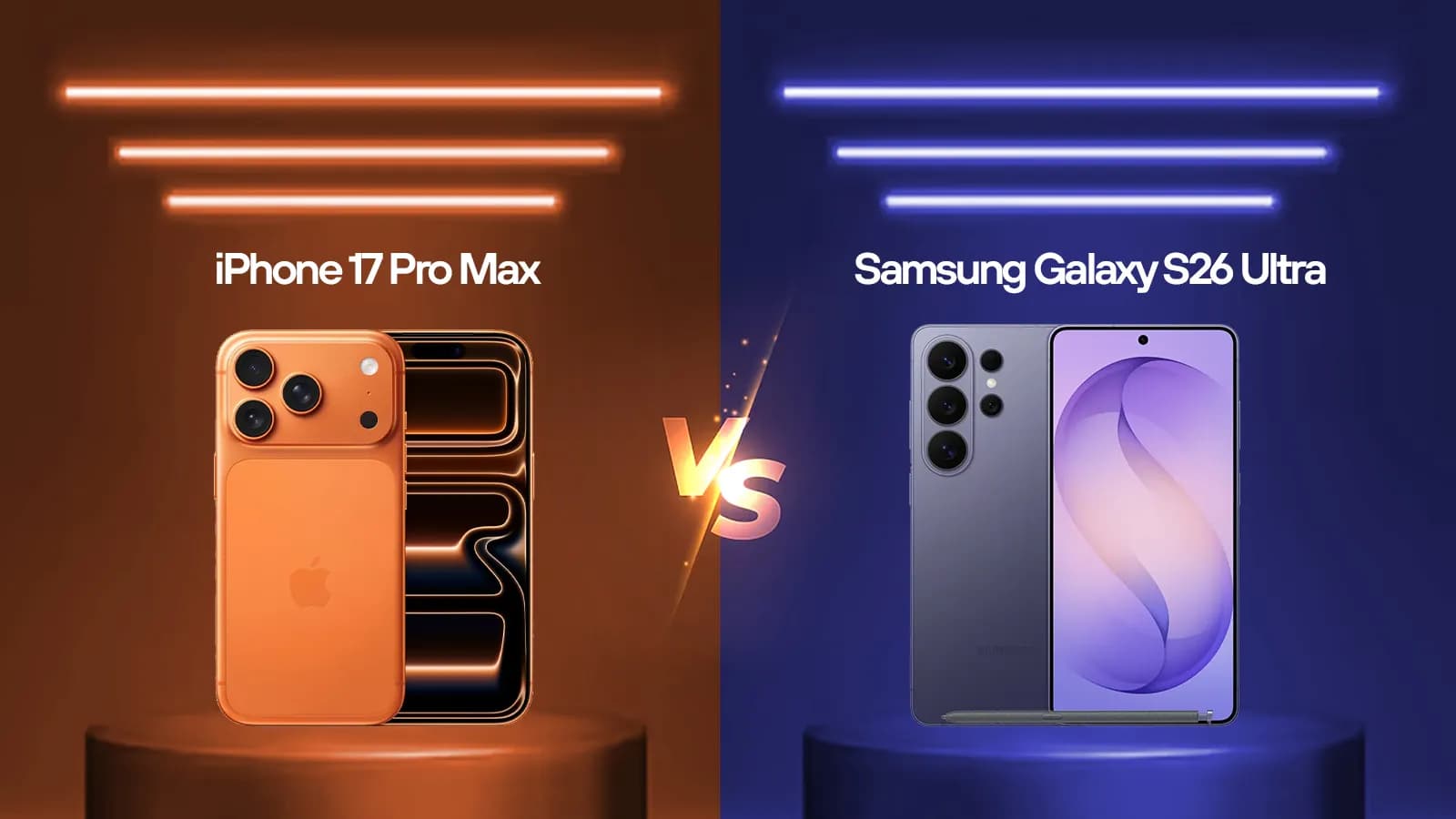
Quick Verdict: iPhone 17 Pro Max or Samsung Galaxy S26 Ultra?
If you want the most complete phone for your money, I would suggest getting the Galaxy S26 Ultra. It costs Rs 17,500 less than the iPhone 17 Pro Max at 256GB, and the difference only widens as we look at their more expensive configurations. For that lower price, there’s still a lot to love about this phone. Like a Privacy Display, a built-in S Pen, a four-camera setup with 3x and 5x telephoto lenses, a promise of seven years of OS updates, and extensive Galaxy AI features. It is the best pick for the latest features and the better value overall.
The iPhone 17 Pro Max earns its premium in three areas I notice every day. The battery gets through a heavy day with more to spare, the vapor-chamber cooling keeps long gaming sessions steady, and the video quality remains the standard other phones chase. So, the value difference is simple: Samsung gives you more phone per rupee, while Apple gives you a more polished video-and-battery machine, plus the whole Apple ecosystem if you already live in it.
iPhone 17 Pro Max vs Samsung Galaxy S26 Ultra Price in Nepal
Variant | iPhone 17 Pro Max | Galaxy S26 Ultra | Price Difference |
256GB | Rs. 242,499 | Rs. 224,999 | - Rs. 17,500 |
512GB | Rs. 284,599 | Rs. 259,999 | - Rs. 24,600 |
1TB | Rs. 327,099 | Rs. 293,999 | - Rs. 33,100 |
2TB | Rs. 411,399 | Not available | Not available |
Note: While the iPhone comes with standard 12GB RAM across all its variants, the Galaxy S26 Ultra brings 12GB RAM for 256GB and 512GB storage, and 16GB RAM for the 1TB model.
iPhone 17 Pro Max vs Samsung Galaxy S26 Ultra: Specifications Compared
Feature | iPhone 17 Pro Max | Galaxy S26 Ultra |
Design | 163.4 x 78 x 8.75 mm, 231 gm; aluminum unibody | 163.6 x 78.1 x 7.9mm, 214 gm; aluminum frames |
Color Options | Cosmic Orange, Deep Blue, Silver | Cobalt Violet, White, Black, Sky Blue |
Display | 6.9-inch LTPO OLED, 2868 × 1320, 120Hz, 3,000 nits peak outdoor | 6.9-inch LTPO AMOLED, 3120 × 1440, 120Hz, 2,600 nits peak outdoor |
Chipset | A19 Pro (3nm) | Snapdragon 8 Elite Gen 5 for Galaxy (3nm) |
RAM | 12GB | 12/16GB |
Storage | 256GB, 512GB, 1TB, 2TB | 256GB, 512GB, 1TB |
Cooling | Vapor chamber (first on an iPhone) | Redesigned vapor chamber with new thermal interface material |
Cameras | 48MP Main, 48MP Ultrawide, 48MP 4x Telephoto; 18MP Center Stage selfie | 200MP Main, 50MP Ultrawide, 10MP 3x Telephoto, 50MP 5x Telephoto; 12MP Selfie |
Video | 4K Dolby Vision up to 120 fps; ProRes, ProRes RAW, Apple Log 2, Genlock | 8K at 30 fps; 4K up to 120 fps, HDR10+; Horizon Lock, APV codec |
Battery | 5,088 mAh (eSIM-only) or 4,832 mAh (SIM tray) | 5,000 mAh |
Charging | Up to 50% in 20 min (40W adapter, sold separately); 25W MagSafe/Qi2 | 60W wired, up to 75% in about 30 min; 25W wireless (no built-in magnets) |
Software | iOS 26 with Apple Intelligence; iOS 27 available as an update | One UI 8.5 on Android 16 with Galaxy AI; up to 7 major OS updates |
Connectivity | 5G, Wi-Fi 7, Bluetooth 6, USB-C (USB 3, 10Gb/s); nano-SIM plus eSIM on the international model | 5G, Wi-Fi 7, Bluetooth 6, USB-C 3.2; dual nano-SIM plus eSIM on the international model |
Productivity | Apple ecosystem features and pro video workflows | Built-in S Pen, Samsung DeX, Galaxy AI and Privacy Display |
Durability | IP68 (up to 6m for 30 min); Ceramic Shield 2 front, Ceramic Shield back | IP68 (up to 1.5m for 30 min); Gorilla Armor 2 front, Gorilla Glass Victus 2 back |
Key Differences Between iPhone 17 Pro Max and Samsung Galaxy S26 Ultra
Design, Build Quality, and Comfort
Okay, starting with its overall design, the very first thing I notice when I switch between them is weight. The Galaxy S26 Ultra weighs 214 gm and is 7.9 mm thick, while the iPhone 17 Pro Max weighs 233 gm and is slightly thicker at 8.75 mm. I know a 19 gm gap doesn’t sound like a lot, but trust me when I say that it adds up during long video sessions or one-handed scrolling. This difference is especially impressive considering the Galaxy S26 Ultra even has a stylus hiding inside it.
Both brands dropped titanium for aluminium this year, and both explain the move as a thermal decision. The glass is where they differ. The iPhone uses Ceramic Shield 2 on the front and a Ceramic Shield panel on the back, while Samsung went with Corning’s Gorilla Armor 2 glass for the display and Victus 2 glass on the back. The 17 Pro Max is also rated for deeper water immersion (6m against 1.5m), but since the camera plateau on its orange and blue finishes is known to pick up scratches easily, I would put a case on either phone.
Winner: Galaxy S26 Ultra for its lighter, slimmer design, and the added S Pen
Display Quality, Brightness, and Anti-reflective Coating
Moving on to the front, the two 6.9-inch displays are excellent for films, games, documents, and everything else. Well, Samsung technically has the sharper display on paper with a QHD+ resolution and roughly 500 pixels per inch (PPI) compared with the iPhone’s approximately 460 PPI. But in most cases, that difference is extremely subtle, unless you’re inspecting fine text, high-resolution photos, or detailed interfaces. As for brightness, the iPhone 17 Pro Max can get as bright as 3,000 nits outdoors, while the Galaxy S26 Ultra maxes out at 2,600 nits.
But looking at PhoneArena’s screen measurement, Samsung actually wins in terms of outdoor brightness, since the S26 Ultra gets as bright as 1,314 nits throughout the display, while the iPhone peaks at 1,098 nits. Moreover, that “Privacy Display” is yet another distinctive advantage with the S26 Ultra, which limits what people beside you can see when enabled. It is really helpful on buses, in cafés, or when viewing sensitive information in public.
And while both phones also have anti-reflective treatments, I found Samsung to be doing a better job at getting rid of screen glare whenever I was outdoors. The iPhone has a few tricks of its own. It supports Dolby Vision, and you can switch PWM dimming off if low-frequency flicker bothers your eyes at night. Samsung’s Extra Dim mode is just as helpful for late-night scrolling, and its speakers sound a little louder and fuller. So if I had to pick the better screen overall, I’d go with the Samsung, but it’s closer than the spec sheets suggest.
Winner: Galaxy S26 Ultra for its sharper resolution, higher brightness, Privacy Display, and better anti-reflective coating
Performance, Gaming, and Thermal Management
Under the hood, both the A19 Pro and the Snapdragon 8 Elite Gen 5 are absolute beasts. And either phone has the performance to handle everything from the most demanding apps you throw at it to current AAA mobile games. So, the more practical question here is how each sustains performance during long sessions. Apple began using vapor-chamber cooling with the 17 Pro series, while Samsung has redesigned the Galaxy S26 Ultra’s vapor chamber and placed thermal interface material along the sides of the processor to spread heat more effectively.
Gaming is where the story changes. In a long graphics stress test, the iPhone 17 Pro Max finishes slightly ahead of the Samsung, and after 30 to 40 minutes of a heavy game, I saw steadier frame rates and no screen dimming. The Galaxy S26 Ultra stays cooler than most Snapdragon phones, thanks to its redesigned vapor chamber, but it does get warm while gaming or charging in summer. For the average user, both phones will feel blisteringly fast, but power users will appreciate the iPhone’s spacious thermal headroom.
Winner: iPhone 17 Pro Max for sustained gaming and consistent frame rates
Cameras and Photography
Alright, the camera is where these two beasts differs the most, and my preference depends entirely on what I’m shooting. The Galaxy S26 Ultra gives you more tools to play with. Its 200MP main camera now opens up to f/1.4, which helps a lot in low light, and the 5x telephoto has a brighter f/2.9 aperture compared to the S25 Ultra’s f/3.4 lens.
Combined with the 3x telephoto and the 50MP ultrawide camera, you get a wide range of framing options, from festival crowds to street photography, portraits, and mountain ridges. Colors are punchy and ready for social media, shadows stay natural, and portraits from the 5x lens have lovely skin tones and subject separation.
Whereas the iPhone 17 Pro Max uses three 48MP cameras, with a new 4x telephoto lens capable of 8x optical-quality crop. Its biggest strength is consistency. Everything from colors to exposure looks almost identical when you switch lenses, which is why I trust it for quick, point-and-shoot moments. The 100mm portrait length is also more practical than the older 5x since I don’t have to stay away from the subject that much. Its selfie camera is another highlight, as the square 18MP sensor lets you take wide group selfies without rotating the phone.
Neither of them is perfect, though. Samsung’s 3x lens struggles in dim light, its night mode can over-sharpen, and fine detail from the main sensor is starting to show its age. Apple’s main and ultrawide sensors are carried over, so image quality is a modest step rather than a leap, and macro still relies on the ultrawide lens.
Winners: Tie (iPhone 17 Pro Max wins on selfies and color consistency, while Galaxy S26 Ultra wins in terms of overall photography and zoom reach)
Video Recording and Content Creation
When it comes to video, I consider the iPhone 17 Pro Max to be the undisputed king of the smartphone world. Its combination of 4K 120 fps Dolby Vision, ProRes, Apple Log 2 support, and industry-leading optical image stabilization results in footage that looks like it was shot on a dedicated cinema camera. I have used it to film fast-moving subjects, and the transition between lenses is so smooth that viewers rarely notice the switch. The front camera also records stabilized 4K and can film you and the scene at the same time with “Dual Capture”.
That being said, Samsung’s video is very good too, and it offers a few things Apple doesn’t. It can record 8K at 30 fps, Horizon Lock corrects up to 360 degrees of rotation, and the new APV codec keeps quality high through repeated edits. Still, video quality is not just a question of resolution. Stabilisation, exposure shifts, skin tones, microphone quality, and transitions between lenses matter when you publish regularly. Apple’s pro formats and established creator workflow make the iPhone the stronger production tool for many users. Whereas for most buyers, Samsung’s 8K recording is more of a talking point rather than a daily need.
Winner: iPhone 17 Pro Max for vloggers, reel creators, and anyone who shoots serious video because of its advanced formats and editing flexibility
Battery Life, Charging Speed, and Wireless Charging
On paper, the battery capacity of both phones looks similar: 5,000 mAh on the Samsung against 5,088 mAh on the iPhone. Oh, but the 5,088 mAh figure belongs to the eSIM-only iPhone. The version with a SIM tray, which is what buyers in Nepal get, has a slightly smaller 4,823 mAh battery. Even so, Apple’s efficiency means the iPhone lasts longer. I got around 8 to 9 hours of screen-on time under heavy use, compared with 7 to 8 hours on the Samsung, and lab tests that simulate active use show the same pattern, at roughly 18 hours against 16 hours. The gap is smaller in standardised browsing and video runs, so I would call it a modest but real edge.
As for charging speeds, the Galaxy S26 Ultra supports 60W wired charging, reaching about 75% in 30 minutes and a full charge in under an hour. Whereas the iPhone takes around 76 minutes to fill up and reaches roughly 50% in 20 minutes with Apple’s 40W adapter.
Wireless charging tops out at 25W on both models, but the iPhone also has magnets built in for MagSafe chargers, car mounts, and stands, whereas you’ll need a separate magnetic case to match that convenience with Samsung. Also, neither phone comes with a charger in the box, so you’ll need to budget for the right adapter if you want the best speeds. And if you use your phone heavily, the iPhone’s battery life is the bigger advantage, but Samsung’s fast charging makes a quick top-up much easier.
Winner: iPhone 17 Pro Max for superior overall battery endurance and a more convenient wireless charging experience; Galaxy S26 Ultra for faster wired charging
Software, AI, and Long-Term Support
Now on the software side, the iPhone 17 Pro Max launched with iOS 26, and Apple has already updated it to the latest iOS 27. The biggest talking point here is definitely “Apple Intelligence”, which has been integrated into the software experience where supported. But I still feel Apple lags in practical AI, and the more personal Siri that Apple promised has not arrived as hoped. Apple’s biggest advantage, however, is often the full ecosystem rather than a single AI feature. If you already use a Mac, iPad, Apple Watch or AirPods, sharing files, moving between devices and keeping services in sync can make everyday tasks feel simpler.
On the other hand, Samsung’s One UI 8.5 on the Galaxy S26 Ultra is equally impressive, offering deeper customization and highly practical Galaxy AI tools like live translation and advanced photo editing. The Galaxy S26 Ultra has received the new Android 17-based One UI 9 upgrade as well, which includes things like “Motion Assist” to help reduce motion sickness while using your phone in a moving vehicle, but it’s not a massive upgrade.
In terms of longevity, I love how Samsung puts a clear number on it by promising 7 years of Android OS and security updates for the S26 Ultra. This is excellent for a phone you plan to keep for years. Apple does not publish a fixed count, though iPhones have a strong history of long support. I would favour Samsung if you like tuning your user interface, managing more complex workflows, or using AI tools across a variety of everyday tasks; and I would favour Apple if you prefer iOS or already rely on Apple services.
Winner: Tie (Galaxy S26 Ultra for customization, richer Galaxy AI features, built-in productivity tools, and its stated seven-generation major OS-upgrade commitment; iPhone 17 Pro Max for people invested in the Apple ecosystem)
Productivity and Ecosystem
If you work a lot from your phone, the Galaxy S26 Ultra is quite hard to beat. The built-in S Pen is genuinely useful for quick notes, signing documents, and marking up screenshots. Split-screen multitasking is also flexible, and Samsung DeX turns the phone into a desktop-style workspace once you plug it into a display. The S Pen still doesn’t have Bluetooth, so remote shutter and slide-clicker functions are gone, but for writing and sketching it’s a unique advantage that I’m sure you’re gonna love once you try it out.
The iPhone 17 Pro Max can still handle everyday productivity comfortably, but its advantage is continuity with other Apple devices rather than an in-phone stylus or DeX-style workspace. AirDrop, iCloud and the wider Apple ecosystem can make it convenient to move between an iPhone, Mac and iPad. My rule is simple: choose the Galaxy S26 Ultra if you want your phone to replace more standalone work tools; choose the iPhone 17 Pro Max if your work and personal devices already revolve around Apple.
Winner: Tie (Galaxy S26 Ultra for on-device productivity and multitasking; iPhone 17 Pro Max for continuity across Apple devices and services)
Which Phone Should Different Buyers Choose?
Category | Our pick | Why it stands out |
Best for everyday use and entertainment | Tie | Both have bright 6.9-inch 120Hz OLED screens, loud stereo speakers for media consumption, and flagship performance. |
Best for photography and zoom | Samsung Galaxy S26 Ultra | The versatile multi-lens camera system, especially the dedicated 3x and 5x telephoto sensors, provides unmatched flexibility for distant subjects. |
Best for video creators | iPhone 17 Pro Max | Industry-leading stabilization, ProRes RAW, Apple Log 2, Genlock, and 4K 120 fps Dolby Vision, with smoother lens switching, make it the more dependable video tool. |
Best for gaming | iPhone 17 Pro Max | The vapor chamber and A19 Pro hold steady frame rates in long sessions and stay cool in well-optimised games. |
Best for productivity and multitasking | Samsung Galaxy S26 Ultra | The integrated S Pen, DeX and flexible split-screen multitasking turn it into a true pocket workstation. |
Best for battery life | iPhone 17 Pro Max | It delivers roughly 8 to 9 hours of heavy screen-on time against 7 to 8 hours on the Samsung. |
Better value for money | Samsung Galaxy S26 Ultra | It is Rs 17,500 – Rs 33,100 cheaper in Nepal at matching storage, and adds faster charging and seven years of updates. |
Buying the iPhone 17 Pro Max or Samsung Galaxy S26 Ultra in Nepal
Authorized vs Grey-Channel Devices
In Nepal, you can buy either phone as an authorized unit or a grey-market unit, and the price difference tempts many people. Authorized phones—which are the ones available at GBN Store—come through the brand’s official distributors (Generation Nxt for Apple, IMS Group and Him Electronics for Samsung), carry a VAT bill, and have the MPIA hologram and the distributor’s seal or label on the box. They do cost a little more because duties and proper distribution are included.
Whereas, Grey units are cheaper but come without an official warranty or VAT bill, which means no free service at authorized centres if something fails. At a price point above two lakh rupees, I would not risk it. The savings on a grey unit rarely cover one bad repair, and Samsung’s authorized units also include one year of breakage insurance.
Not just that, you can also get the iPhone 17 Pro Max and Galaxy S26 Ultra on 0% EMI for 12 months from authorized stores. The catch is that you’ll need a credit card for the iPhone, but that’s not necessary for Samsung phones. And interestingly, Samsung has recently started offering 24-month EMI on its Galaxy S series too, with an interest rate of 7.99%.
Warranty and After-Sales Service in Nepal
An authorized purchase is what activates your warranty and your right to service. Keep the VAT bill and the box until the warranty ends, because service centers can ask for both. On the Galaxy S26 Ultra, the one-year breakage insurance is a practical bonus in a country where cracked screens are common, and it softens the cost of owning a large, glass-backed phone.
Whereas with the iPhone 17 Pro Max, you get 2 times front screen and back glass replacement for free within two years, and a 1-year extended warranty. Before leaving the store, I would advise you to inspect the screen, cameras, speakers, buttons, charging port, and SIM recognition, and check that the device activates normally. If you are buying online, understand the return window and what counts as an eligible defect before opening or setting up the phone.
MDMS Registration and IMEI Verification
Nepal’s Mobile Device Management System (MDMS) is strictly enforced, meaning any unregistered phone will eventually be blocked from local networks. Before buying, I always ask the seller to verify the device’s IMEI on the official NTA (Nepal Telecommunications Authority) portal. This simple step guarantees that the phone is legally imported and will not suddenly lose cellular connectivity. Keep in mind that a dual-SIM model may show more than one IMEI, so check each one rather than assuming one successful lookup covers every SIM slot.
Regional Variants and Physical SIM vs eSIM Compatibility
SIM configurations of the same phone can differ by region. Apple makes eSIM-only versions of the iPhone 17 Pro Max for markets such as the US, the UAE, Saudi Arabia, Qatar, Japan, and Canada, with no SIM tray at all. Other markets, including Nepal, get a version with a physical SIM tray and a slightly smaller battery. Samsung follows a similar pattern, with the international Galaxy S26 Ultra supporting two physical SIMs plus eSIM, and the US version offering one physical SIM plus eSIM. The US models also use different network bands.
So before buying, check the model number in Settings, and confirm that your operator supports eSIM on your plan if the phone is eSIM-only. While Nepali carriers are gradually improving eSIM support, I still prefer devices with dual physical Nano-SIM trays for maximum flexibility, especially when traveling or switching between NTC and Ncell.
Availability, Storage Options, and Resale Value
The iPhone 17 Pro Max comes in 256GB, 512GB, 1TB, and 2TB storage options, so those who install a lot of heavy games or shoot a lot of videos have a real option at the top end. The Galaxy S26 Ultra stops at 1TB, and its 12GB and 16GB RAM split by storage is worth remembering: only the 1TB model carries 16GB. For most people, 256GB is enough on either phone if you use cloud storage, while anyone recording ProRes or 8K video should look at 512GB or more, since neither phone has a memory-card slot.
In terms of resale, iPhones generally tend to hold their value better in the second-hand market, which partly offsets their higher purchase price. The Galaxy S26 Ultra’s pricing has swung more, which makes its resale value harder to predict. For either phone, resale depends heavily on battery health, remaining warranty, and whether you still have the original box and bill as well, so make sure to keep them in good condition.
Frequently Asked Questions
1. What is the price of the iPhone 17 Pro Max in Nepal?
The iPhone 17 Pro Max starts at Rs. 242,499 for the 256GB model, then rises to Rs. 284,599 for 512GB, Rs. 327,099 for 1TB, and Rs. 411,399 for 2TB. Prices and stock can change, so confirm the final invoice price with the seller.
2. What is the price of the Samsung Galaxy S26 Ultra in Nepal?
The Galaxy S26 Ultra costs Rs. 224,999 for the 12GB/256GB model, Rs. 259,999 for 12GB/512GB, and Rs. 293,999 for the 16GB/1TB model. It was cheaper a few months ago, so you should confirm the final price before making the purchase.
3. Should I buy the Galaxy S26 Ultra instead of the iPhone 17 Pro Max?
I would choose the Galaxy S26 Ultra if you want the S Pen, Privacy Display, more dedicated zoom options, DeX, and broader multitasking features for a lower listed price. The iPhone 17 Pro Max is more compelling if your priorities are video production, gaming-focused workflows, Apple-device integration, or its published battery-endurance claim.
4. Which is cheaper in Nepal, the iPhone 17 Pro Max or the Galaxy S26 Ultra?
The Galaxy S26 Ultra is cheaper at every storage size they share, by Rs. 17,500 at 256GB, Rs. 24,600 at 512GB, and Rs. 33,100 at 1TB. I would still compare the warranty, regional variant, and included accessories before deciding which offer is better.
5. Should I upgrade from the iPhone 16 Pro Max to the iPhone 17 Pro Max?
In most cases, I’d wait. You get a new design, better cooling, and roughly 10 to 15% better battery life, but the display and everyday speed feel very similar. If your battery is still healthy and the phone feels fast, I don’t think the upgrade is worth it.
6. Is the Galaxy S26 Ultra worth upgrading to from the S25 Ultra?
Only if the Privacy Display, 60W charging, or the slimmer, lighter body matter a lot to you. The cameras and the S Pen feel familiar, so I think owners of an S23 Ultra or older get the most out of the jump.
7. Which phone has the better camera, the iPhone 17 Pro Max or the Galaxy S26 Ultra?
I give the Galaxy S26 Ultra the edge for photography because of its 200MP main sensor and 5x periscope zoom. The iPhone still wins for selfies, color consistency, and video, so the answer depends on what you shoot most
8. Which phone has the better battery life in real-world use?
The iPhone 17 Pro Max lasts a little longer, with around 8 to 9 hours of screen-on time against 7 to 8 hours on the Galaxy S26 Ultra. The Samsung charges much faster, though, so I find it easier to recover during a busy day.
9. Do the iPhone 17 Pro Max and Galaxy S26 Ultra support physical SIM and eSIM in Nepal?
The international versions of both phones have a physical SIM tray along with eSIM support, and that’s the setup I’d recommend for Nepal. If you’re considering an eSIM-only iPhone from abroad, you’d be happy to know that both NTC and Ncell offer eSIM service as well.
10. Which phone holds its resale value better in Nepal?
From my experience tracking the local market, the iPhone 17 Pro Max retains a significantly higher percentage of its original price after a year compared to the Samsung Galaxy S26 Ultra.
Final Verdict: iPhone 17 Pro Max or Samsung Galaxy S26 Ultra?
Both of these are among the best phones you can officially buy in Nepal today, and neither is a bad choice in any way. When I put price and experience side by side, though, I keep coming back to the same conclusion. At today’s Nepal prices, the Galaxy S26 Ultra is the phone I would recommend to most buyers. It is Rs 17,500 cheaper than the iPhone 17 Pro Max at 256GB, lighter in the hand, better for photography and zoom, faster to charge, and more useful for work, with a seven-year update promise that makes it a safe long-term purchase.
That said, the iPhone 17 Pro Max is not a lesser phone, and I would never talk a certain type of buyer out of it. If you shoot a lot of video, play demanding games for long sessions, or want the longest battery life, the iPhone is the more capable tool. And if your laptop, watch, and earbuds are all Apple, the ecosystem benefits quickly justify the premium.
Ultimately, I cannot declare a single, absolute winner because both phones are masterclasses in modern flagship smartphone experience. Whichever you pick, buy it from an authorized seller like GBN Store, verify the MDMS status, and keep all the paperwork safe.